More Russian Lies

On December 29, 2021, I published a 15,000-word article detailing some of the lies Russia has been telling about the disaster situation they caused in Ukraine. I honed in on three key facts; namely, that communism never fell in Russia and that the hardliners are still pursuing the same old agenda, that Russia is not surrounded by NATO, and that Russia is the aggressor. Today, I want to expand my analysis and cite several more of Russia’s deceptions that are hoodwinking people high and low in the West. 

First, I want to give a quick overview of the last eight years. In 2014, Russia backed a coup that deposed the Ukrainian president while pretending to support him – then blamed it on NATO. Using this as a pretext, Russian supporters in Donetsk and Luhansk – the region known as Donbass – declared independence. This was of course supported by Russian troops and mercenaries. Russian soldiers simultaneously stole Crimea, which Putin then annexed. Leonid Ragozin called the annexation a “masterclass in political manipulation,” stating: 

“Putin succeeded in using a revolution that could have spelt the end of his regime to his advantage by forcing Russia’s entire population into binge watching daily episodes of an endless series about Ukraine burning in hellfire.” 

The endless streaming of malicious propaganda against Ukraine continues today with Ukraine being depicted as an illegitimate vassal state of NATO or the United States – a state that is literally perpetuating “genocide,” a claim Putin has now made more than once and is using as a justification for Russian intervention in Ukraine. 

Going back to 2014, however, I would be remiss if I didn’t note that a total of 5% of Ukraine was stolen and placed under outright or de facto Russian control. Russia has since granted almost 1 million Ukrainians in these stolen territories Russian passports and citizenship, partially to convert the area in Russia proper and make claims of “defending” its people more tenable (which is the reason Russia has engaged in mass settler colonialism throughout its former satellites states) and partially to reverse bad demographic trends. As Ukraine has justly fought back against these Russian-supported separatists and their Kremlin controllers, some 14,000 people on both sides have perished. 

A few days ago, as alleged Ukrainian saboteurs were being caught crossing into Russia and a supposed bombing attempt was being thwarted by Luhansk authorities, the Russian Duma approved a proposal to recognize Luhansk and Donetsk as independent states. On February 21, Putin approved the proposal. One of the stunning things about this move is that Luhansk and Donetsk claim control over territory that they actually don’t control and which is controlled by Ukraine. What if Ukraine decides to exert its control over its own territory in these falsely claimed areas? Will Putin call this an “invasion” or “aggression” and go to war to “defend” the newly independent states? 
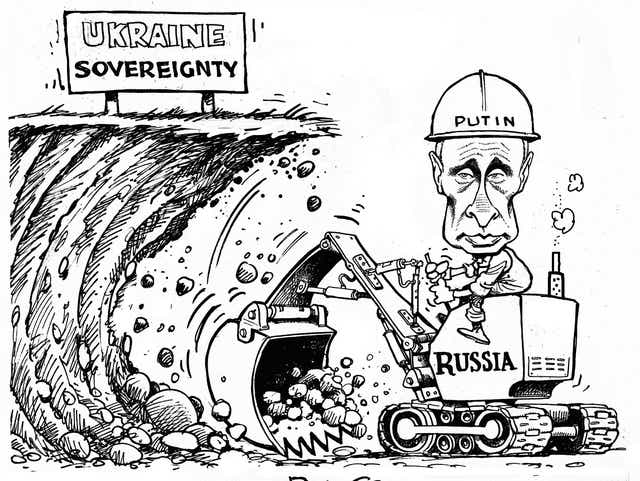
Perhaps the point is mute because as incredible as it is to steal a nation’s territory and then recognize the territories’ “independence,” the old KGB tactician took it a step farther. Immediately upon recognizing the so-called “independence” of Luhansk and Donetsk, Putin ordered Russian troops into the region to “maintain peace.” Is this how you treat an “independent” state, by occupying it with your soldiers? Can it truly be called “independent” when, on day one, a foreign military under the command of a foreign dictator enters and takes over? Hardly! 

This is conquest by any other name and I’m losing my mind watching Alex Jones, Jeff Rense, and others justifying this invasion. Now, because of these latest developments, any Ukrainian action against the separatists in what is rightfully Ukrainian territory will risk the chance of engaging Russian forces and igniting a larger war. If that happens, remember it was Vladimir Putin who made it so. Glenn Beck has a mostly-accurate segment from his show on this news which a follower of one of my Facebook pages sent to me this morning and which I commend to you. 

Numerous sources are now reporting 10,000 Russian troops have already entered Donbass, though reports are a little hazy. Whether boots are actually on the ground yet or not (they’ve been there for eight years in one form or another, so why wouldn’t be), the Red Tsar’s decree exists and will be acted upon sooner or later. KGB dictator Putin, after sending in troops, requested the Duma to grant him authorization to use military force outside of Russian territory.  

The false narrative that Russia is the “savior” has again been repeated and fortified by the events. And the gullible fools in the West remain oblivious to the fact that Russia has orchestrated this entire episode using classic Soviet tactics of subversion, deception, and manipulation. 

Now, let’s proceed with Russia’s lies about Ukraine and NATO and the tactics they’ve used to steal part of Ukraine for themselves. The first thing that comes to mind is Vladimir Putin’s fatalist, alarmist, and, frankly, psychotic, rhetoric. First, he has continuously lied about NATO aggression, expansionism, and threatening Russia’s borders. I’m no supporter of NATO, but I’m also not a friend of lies and distortions. I dispensed with this absurdity in my “Russia Lies” article mentioned earlier, but the fact of the matter is that the majority of states bordering Russia are not NATO members, including Ukraine.  

Another fact is that the only states bordering Russia that are in any way hostile and which also contain NATO forces are those, like Estonia, which invited NATO forces to be stationed there AFTER Russia engaged in hybrid-warfare against them. It’s essential you understand the old communist shtick of proclaiming innocence in all things while blaming the enemy for the exact same things you are in reality doing or planning to do. Trained in KGB subversion tactics, Russia plays the victim card masterfully. But Russia isn’t a victim of anything except its own communist regime’s tyranny and conquest ambitions. 

Since I’ve been closely studying Russia, not a year has gone by that some Russian leader or general hasn’t threatened NATO or the United States with nuclear war. It’s a sick compulsion. If anyone in the West ritualistically threatened Russia or China with nuclear war, we’d rightly call him a lunatic. Vladimir Putin is a lunatic. I cite but three examples of his nuclear rhetoric. 

Last week, while in France, Putin fumed at his audience, warning them how quickly he would drop atom bombs on their heads in the event of NATO interfering in Ukraine: 

“Do you understand it or not, that if Ukraine joins Nato and attempts to bring Crimea back by military means, the European countries will be automatically pulled into a war conflict with Russia? 

“Of course, Russia and Nato [military] potentials are incomparable. We understand it. But we also understand that Russia is one of the leading nuclear states. 

“There will be no winners, and you will be pulled into this conflict against your will.” 

“You won’t even have time to blink your eye when you execute Article 5.” 

Imagine if doddering Biden said he would strike third-party nations with nuclear weapons if any of their allies attacked, say, Canada. That’s essentially the situation. That’s what Putin is saying. If NATO dares to help a smaller nation who has been attacked by Russia defend itself against further Russian aggression, then Russia will drop nuclear weapons all over Europe. Think of how maniacally insane that is! 

But this isn’t the first, and I doubt it will be the last, time that Putin has made such threats. In 2018, he again played the victim card, but still managed to voice his willingness – in seconds – to order a nuclear strike: 

“Our strategy of nuclear weapons use doesn’t envision a preemptive strike. Our concept is a launch under attack. 

“Only when we become convinced that there is an incoming attack on the territory of Russia, and that happens within seconds, only after that we would launch a retaliatory strike.” 

It should be noted that the nation that fires nuclear missiles second will be in better shape than the one that fires first, nullifying any idea Putin may have intended to convey about Russia’s benevolence.   

Finally, in a 2014 military document, Russia made a statement that puts Putin’s threats – most of which I haven’t included here – in better context: 

“The Russian Federation reserves the right to use nuclear weapons in response to the use of nuclear and other types of weapons of mass destruction against it and/or its allies, as well as in the event of aggression against the Russian Federation with the use of conventional weapons when the very existence of the state is threatened.” 

Putin would be willing not only to launch missiles if missiles were headed for Russia, which is understandable, but he is formally, on paper, prepared to launch nukes even in a conventional war or “in the event of aggression against the Russian Federation.” It should be alarming, then, to hear Putin so frequently accuse NATO of aggression and of threatening Russia. 

What’s more, Putin has taken to accusing Ukraine of literal genocide in Donbass. He said that, in Russia’s analysis, what’s happening “constitutes genocide.” Apart from the larger and more obvious false claims of the Allies against Germany, search the Katyn Forest Massacre. For years, the massacre of 10,000 Polish officers was blamed on Germany. Germany denied it, but no one listened. Only later was it confirmed that the Russians had perpetrated the slaughter and then blamed it on Germany – the world Elites’ favorite scapegoat. 

Back to Russia and Ukraine. Using the claims of “genocide” and imminent invasion as a pretext, the Russian-backed rebel authority of Luhansk, Leonid Pasechnik, and of neighboring Donetsk, ordered an immediate evacuation of all residents to Russian territory and called all able-bodied man to arms. In my Red Alert newsletter of February 19, I said: “Perhaps he’s clearing the area for Russian armor and troops to occupy the area or make an offensive.” 

Two days later, my prediction came true as Putin ordered Russian military into the area to “maintain peace.” “Maintain peace,” in Putin speak, is the same as “normalize” in Soviet speak; that is, to put down all dissent and take control of an area. Russia loves to create pretexts to send in troops as “liberators.” Think of Afghanistan, Syria, Georgia, Crimea, Armenia, and so forth. The Soviets said it’s impossible for communists to be the aggressors because they’re always fighting the true oppressors of humanity – capitalists, Christians, etc. Russia is carrying forward the same ridiculous claims today. 

Tellingly, the evacuation order was pre-recorded on February 16, but released only February 18. In the video, they use the word “today,” though that is an apparent fabrication. Radio Free Europe/Radio Liberty reported: 

“Videos of Russia-backed separatists in eastern Ukraine ordering an “emergency” evacuation posted on February 18 were actually filmed on February 16, an analysis by RFE/RL’s Russian Service of metadata from the messaging app Telegram shows. 

“In the video posted online and on Telegram on February 18, Denis Pushilin, the de-facto head of the separatist-occupied Donetsk region, claimed an increase in the number of Ukrainian military personnel and weapons along the line of contact. 

“He ordered the evacuation, claiming that Ukrainian President Volodymyr Zelenskiy was soon to give an order to “invade the territory” of separatist-controlled areas of the Donetsk and Luhansk region. 

“A leader in the separatist-controlled Luhansk region issued a similar call based on similar claims. 

“An investigation by RFE/RL’s Russia Service shows that the videos were actually made on February 16, indicating that the sudden evacuation was actually preplanned.” 

Remember the United States warning of a Russian false-flag event? Could this be it? Russia and the separatists alike are claiming that Ukraine is currently shelling Donbass, committing “genocide,” and is preparing to invade. Recall and apply what I said about Putin blaming the enemy for the very things he’s doing or planning to do. 

Oleksiy Danilov, Ukraine’s top security chief, responded to the allegations simply: “There are no orders to liberate our territories by force.” I love that he said “our territories,” because the Donbass is rightfully Ukrainian sovereign territory which was broken off by Russia, which now uses any Ukrainian move in the area to claim “aggression” and “genocide.” 

In an interview with Dr. Lada L. Roslysky, the founder of the Black Trident Defense Group out of Kiev, Molly Gambhir of WION news asked about Russia’s claims that five Ukrainian saboteurs had been killed in a firefight while trying to sneak into Russia. She gave a great comment: 

“We’ve become quite cynical to these types of claims because they’re false claims. What is on the Ukrainian territory is the Russian armed forces. And Russian weaponry is already in Ukraine and they have been there for eight years. We are completely surrounded. And when we are listening to the Kremlin, we should always look into it like a reverse mirror: What the Kremlin claims is what the Kremlin is actually doing.” 

I’ve been saying the same thing for years. Communists are incapable of telling the truth. Even when they tell the truth, they lie – because they tell it out of context or to suit an agenda by which telling an unsavory truth will harm their geopolitical adversaries. Putin, the schooled KGB master he is, used these types of doublespeak and reverse reality tactics constantly. 

As noted above, Russia has now sent potentially 10,000 troops into Donbass. What I didn’t write then, because the situation is so fluid that it changes and updates every hour, is that the Russian Duma have now, only after the fact, unanimously approved Putin’s “request” to send troops into foreign territory. Such is the sham dictatorship posing as a “democracy” that is Russia. If you know anything about how Stalin ruled the Soviet Union by fiat, you see its shades in Putin’s Russia. 

One of the lies Putin has been peddling about the situation is that Ukraine is the aggressor and doesn’t want peace. What of the Minsk Accords? What of the Budapest Memorandum? What of Ukraine’s various peace proposals? Russia never followed either the Minsk Accords or Budapest Memorandum, so why should they play nice when Ukraine asks for peace? 

In “Russia Lies,” I talked about the Minsk Accords and the ways Russia has violated them from the beginning. But what of the Budapest Memorandum signed in 1994? In it, the United States, UK, and Russia pledged to “to respect the independence and sovereignty and the existing borders of Ukraine” and to refrain from force or violence. It also stripped Ukraine of its massive stockpile of nuclear weapons – its only real deterrent to Russian aggression. Sadly, Russia didn’t abide by the Budapest Memorandum just as it ignored the Minsk Accords. Ukraine’s claims against Russia are just and Russia’s claims are just . . . garbage. 

Part of Putin’s underlying motivation for invading Ukraine is the notion that Ukraine never really existed, but has always been part of Russia. Historically, this claim has legs, though it’s not so cut-and-dry. The name Russia originated in the name “Rus,” which was historically located in Ukraine. Ukraine, not modern Russia, was the birthplace of the Russian people, Russian Orthodoxy, etc. The center of power shifted, however, to Moscow. The state of “Ukraine” as we know it today only came into existence in 1991. Yet, Ukraine – especially Western Ukraine – is home to peoples who have always resented Russia and who speak a different language. Some of these are Cossacks who have always had a tense relationship with Russia. 

I share this truncated view of Ukrainian history to give context to a comment Putin made that gives us a bird’s eye view of his rationale. I quote from a surprisingly good Yahoo!News article

“In a speech announcing his decision, Putin said that “Ukraine for us is not just a neighboring country. It is an integral part of our own history, culture, spiritual space,” according to a translation provided by The New York Times. He also claimed that Ukraine has “never had a tradition of genuine statehood” and that “[m]odern Ukraine was entirely created by Russia, more precisely Bolshevik communist Russia,” according to Reuters. Therefore, Putin claimed, “decommunization” should have entailed the re-incorporation of Ukraine into Russia. “We are ready to show you what real decommunization means for Ukraine,” Putin said.” 

If Putin wants to “decommunize” something, he should start by ordering his military to remove the hammers and sickles from their equipment, by changing the music of Russia’s national anthem (which is the Soviet anthem tune and was handpicked by Putin), and then by resigning from the Russian government. He is, after all, a KGB mafioso. 

The rest of his comment is somewhat revealing in its implications. Ukraine wasn’t the only state created by Soviet Russia. The Baltic states were created by Russia. The “stans” were engineered by Russia, too. Extending Putin’s logic, does Russia, then, have a right to incorporate – whether by hook or cook – these now independent nations back into Russia? If Putin can simply dismiss Ukraine’s sovereignty and conquer their nation by saying Russia created them, then why can’t he do the same for Estonia or Tajikistan or Palestine (the PLO was created wholly by Soviet intelligence, and their current president, Mahmoud Abbas, was trained in Soviet Russia, as was Egyptian-born Yasser Arafat. Iran’s Ayatollah was KGB-trained, too, in case anyone was curious. So were the Iraqi Republican Guard, which became the leaders of ISIS). 

Putin’s logic is, of course, intellectually bankrupt. What kind of world would this be if any nation that ever created another nation could simply take it back and claim it as their own? Most of the geopolitical map of Africa, though preexisting in their various tribal entities, was drawn up by European states – France, England, Italy, etc. Does Putin think they should be able to take them back? They created their distinctive borders and nation-states, after all. 

Let’s pull this article back to reality. Here’s another Russian lie. Russia swore that its annual military drills in Belarus would end when scheduled (February 20) and that Russian troops would head home. When a limited number of Russian troops seemingly did go home, many in the West cheered and said NATO was wrong and Russia followed through on its word. They spoke too soon. 

It turns out that Russia’s “partial withdrawal” and ending of drills was a fiction. Belarus has announced that Russian troops will remain “indefinitely” in Belarus – to defend Belarus, of course. 30,000 are there now with a large amount of tanks, jets, and equipment. And, so, Russian troops are not only along Ukraine’s border, but are moving into the newly “independent” states in Donbass. 

Where are all the “conservatives” and media talking heads who cheered Putin’s integrity now? They’re making excuses, dodging reality, blaming NATO, or buying claims of “genocide” which, naturally, justify the “unexpected” change of plans. Can’t we finally admit Putin lied? And can’t we also acknowledge Russia’s contradictory claims – first there was no mass buildup up of troops, then the troops were being withdrawn? It’s one lie on top of another. 

Some are justifying everything that’s happened over the past eight years by the fact that, on the whole, the people of Donbass are happy to be either independent or Russian citizens. In a normal situation, I approve and applaud the right of self-determination. However, that’s not what happened here. None of this was organic. It was all orchestrated by the Kremlin. 

Let’s do a little comparison. If Chinese troops moved into San Francisco and occupied it, and the high Asian population there cheered, would that be justified? Would it be justified if the Asians there had a referendum and voted to become part of China? 

If that’s an absurd example, let’s use one closer to home. Much of the current Western United States was inhabited by Mexicans or Spanish-speakers before the territory fell into U.S. hands. Would they be justified, then, in passing referendums to join Mexico and break off from the United States? What if Mexican mercenaries or drug cartels entered Arizona, or Texas, or California, and sealed off a section of territory, declaring it to be independent and no longer under Washington’s control?  

Just for emphasis, let’s use a third example. Would the American Indians be justified in rising up to reclaim some of their lands? They already possess “nations” that aren’t really part of the United States. What if they decided they wanted some of their traditional lands back and sent out their braves to, by force of arms, cut off a slice of, say, Virginia. What if the people of that area agreed that the Indians should probably have that territory? What if they were even happy about it? Would that be justified? 

Would any of this be justified? Of course not! None of these are organic movements. Each example I’ve used employs force and compulsion. Such is the case in Ukraine. The people of Donbass, in a time of peace, didn’t simply vote to leave Ukraine. If they had, I’d support them. However, they were aided by foreign mercenaries and troops to force a separation. This separation has been contested by the power rightfully controlling that jurisdiction. 14,000 people have died as a result and war continues to rock the area. 

The foreign mercenaries and troops, of course, were Russians. They were sent there with the deliberate purpose of breaking off Donbass from the rest of Ukraine as part of a long-term strategy of consuming Ukraine piecemeal. Recall that Russia outright stole and annexed Crimea. In all, Russian troops aided local rebels in cutting off 5% of Ukraine’s total territory and enforcing the separation, later hastily voted on, at the point of the sword. None of this is justifiable. It’s invasion and conquest by any other name. And if it happened to us, we’d go to war and wouldn’t allow it. But when Ukraine fights back or dares raise any complaints about their illicitly stolen territory and population, stolen through force of arms by a foreign enemy, Russia accuses them of “genocide,” expansion, and aggression. It would be laughable if it wasn’t so serious and if so many gullible people weren’t going along with the narrative. 

The most disgustingly asinine and repugnant comment I’ve heard so far regarding Putin’s order to send troops into Ukraine was made on The American Journal radio show, a branch of InfoWars. Most of what Alex Jones and the various other co-hosts say is correct. However, just as they did in 2014, they’ve chosen the wrong side in the Ukraine situation. To wit, the imbecilic comment I refer to was made today, February 22, by Harrison Smith and said: 

“Thank God, thank God, somebody is standing up against the imperialist war hawks that now run this country and have occupied the American government. It’s not me. It’s not me they’re at war with, that Russia’s at war with. It’s not the American People that Russia’s at war with. It is the despicable and detestable cabal that runs our country. So, good riddance to them; good luck Russia. I don’t know, maybe, you know, when Texas breaks away, Russia will be there to declare us a sovereign state – a sovereign, breakaway, independent nation. I don’t know, it might be nice.” 

I’ve rarely heard anything so stupidly ignorant and so blatantly treasonous as this blather. I’d fire Harrison Smith immediately, if I were Alex Jones. The only thing despicable here is the idea that an American would welcome Russian troops into America. If Russian troops come into my community, it’s an act of war and I’ll open fire. I’m sick of Russian aggression, Russian hypocrisy, and Russian lies. We have enough of that in America – we don’t need to deal with it from a foreign, paganized, communist nation like by a KGB agent who has said the (fake) fall of the USSR is “the greatest geopolitical catastrophe of the century.” Click the hyperlink to watch a forty-two-minute presentation on my Liberty Wolf podcast about the fake fall of communism. It’s crucial to understand this deception. 

The final myth I want to bust is that Russia and Putin stand in opposition to the Western New World Order. This is utterly absurd. Let’s start with a fun fact. There’s been plenty of news, especially from the alternative media, about Klaus Schwab and the World Economic Forum. Alex Jones, in particular, has been rightly ranting every day about the WEF’s admitted influence throughout the world and how numerous world leaders, such as Justin Trudeau are devotees and trainees of the WEF. What about Putin? Did you know that Vladimir Putin, the so-called savior from the new World Order, is a member of the World Economic Forum and Davos group and that he has been attending their forums for years? Surprised? 

In January 2021, Klaus Schwab personally introduced Dictator Putin for a speech at the Davos summit in Switzerland, eagerly stating: “Mr. President, the world is waiting to hear from you.” What did Putin say to the world? You can watch his address here and read the official transcript here. But here’s how Putin began: 

“I have been to Davos many times, attending the events organised by Mr. Schwab, even back in the 1990s. Klaus just recalled that we met in 1992. Indeed, during my time in St Petersburg, I visited this important forum many times. I would like to thank you for this opportunity today to convey my point of view to the expert community that gathers at this world-renowned platform thanks to the efforts of Mr. Schwab.” 

In the talk, Putin parroted the same propaganda we hear from our overlords here in the West. He played his part, bashing the United States, putting down free enterprise, and touting Russia’s great accomplishments for the world, but, if you pay attention, he also praised the World Bank, applauded the global COVID-19 response, pushed vaccines and called for a mass vaccination program in developing countries, called for international coordination to save the climate, referred to the hoax of “global warming” as a “critical problem” that required international “cooperation” to solve, and so forth. I don’t like the term “globalist,” but if anyone is a “globalist,” it is Putin. 

Isn’t it interesting that the ostensibly anti-New World Order Putin is so friendly with the very organs of world government and that he has so many decades of experience working with them? He considers them “experts” and is on a first-name basis with “Klaus.” If the Alex Joneses of society rip on Trudeau for being a WEF stooge, why don’t they also condemn Putin for being on the same side? To bash one but not the other for the very same connections is hypocrisy. 

Why would Putin be hobnobbing with Klaus Schwab – the architect of the Great Reset – and the world financial Elite that hold sway in the West if he was truly their enemy and opposed their agenda? Why would Putin be implementing WEF, Davos, and U.N. policies in Russia if he was opposed to this cabal? The fact is, of course, he’s playing for the same team. When will people understand that the cabal that threatens us is an international cabal and has its agents in every nation? 

A Breitbart headline from yesterday tells it all: “Russia Presides over U.N. Security Council Meeting on Russian Aggression.” The article states: 

“Ukraine requested an emergency meeting of the U.N. Security Council (UNSC) on Monday night in response to Russia’s military incursion. 

“The rotating presidency of the UNSC happens to be held by Russia at the moment.” 

Russia is ensconced in global governance. Communists are the true “globalists.” Their entire program, which Putin was trained in and adheres to, is internationalist and seeks world hegemony with its partner in crime, Red China. There’s no shady, underhanded, thieving, corrupt, conspiratorial, murderous, genocidal thing you can imagine that Russia – both in the Soviet era and today – haven’t engaged in. 

From abortion to transgenderism to political correctness to the psychopolitics of medicine to mass surveillance, most of the ills that plague the West first came from Russia. Trust me, as one who lived in Russia for two years and spent my time talking with average folks and observing, it is a crass, violent, and degenerate society. I talked about this at length in “Russia – Bastion of Traditionalism?” 

I’m of course speaking collectively and not individually; there are some great Russians with beautiful souls. But their parasitic system, which exists in the West, too, has left deep scars on Russian society and Russia has been used for a century as a base of operations against humanity. Those raised in this culture of communist corruption and perfidy are among the foremost of those who, though they are perpetrating horrors, are now seen, because of mass deception, as liberators, saviors, and heroes. 

Why would Putin allow this state of affairs to continue in his country if he was truly against it? Why wouldn’t he use his dictatorial powers and mass wealth to curb the corruption, stop the global disinformation campaigns, or stop his nation’s cyberattacks on other countries? Why did his operatives help the Democrats in their false “collusion” narrative against Donald Trump? Why would he send his people to arrest his political opposition or poison dissidents? Would an honest, Christian man, as Putin alleges he is, do these things? 

Putin has gone along with the Western Elite’s machinations at nearly every turn. He was the first to support George W. Bush’s “war on terror” after 9/11. He went along with COVID-19 scaremongering and locked his country down. He then mass-produced vaccines and delivered them all over the world. He supports the ludicrous “global warming” hoax. Russia has been a host of numerous transhumanist conferences and, in fact, is home to billionaire Dmitry Itskov’s “2045” project. These transhumanists plot to subjugate mankind and fuse us to machines in some sick mirror of the Matrix.  

Why would Putin allow these transhumanist conferences in his country if he was so opposed to their goals? Why would he participate with the World Economic Forum for thirty years? Why would he have assassinated dissidents, jailed his biggest political rival, and rigged elections if he was such a good statesman? Why would he have invaded and intervened in nations from Georgia to Ukraine to Armenia to Kazakhstan to Syria if he was such a peace-loving man?  

Is Vladimir Putin not smart enough to see the agenda of the transhumanists and world economic Elite? Is he to narrow-minded not to comprehend the great conspiracies swirling around him? Of course he knows their agenda! He’s part of the conspiracy! The only difference is that he wants to be the one leading it and doesn’t want to play second fiddle to anyone. 

These types of questions and observations could be made ad nauseum. The same questions could be asked of Putin’s closest ally, the Chinese dictator Xi Jinping. His Davos 2022 speech, which openly calls for more globalization, may be read here. All of these dictators, whether Putin in Moscow or Xi in Beijing or Biden in Washington or Trudeau in Ottawa, belong to the same clubs and share the same ideals. That they squabble about lesser things is tangential. None of them actually care about Ukraine. It’s a pawn in a larger scheme whose stakes are the world. But the game must be played the right way to fool the pawns and to get them to go along, for, without them, the Elite have no power. 

Most of the big names that dominate the news are Illuminati-communists or their puppets and belong to the same occult conspiracy. Whether in the East or the West, they’re Marxist-Leninists in principle and believe in the almighty state. They are the high priests of Lucifer and will, together, each playing his part, eventually damn humanity. 

Zack Strong 
February 23, 2022 
Andrew Jackson – A Hero For All Time

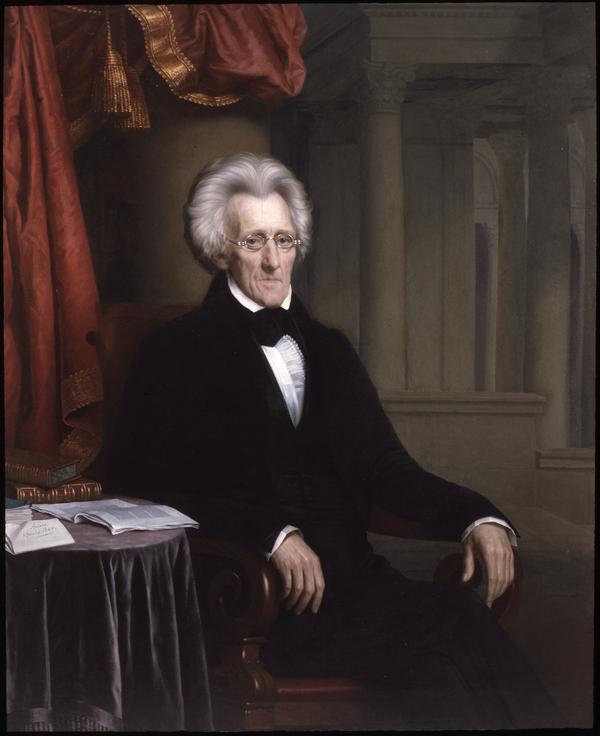
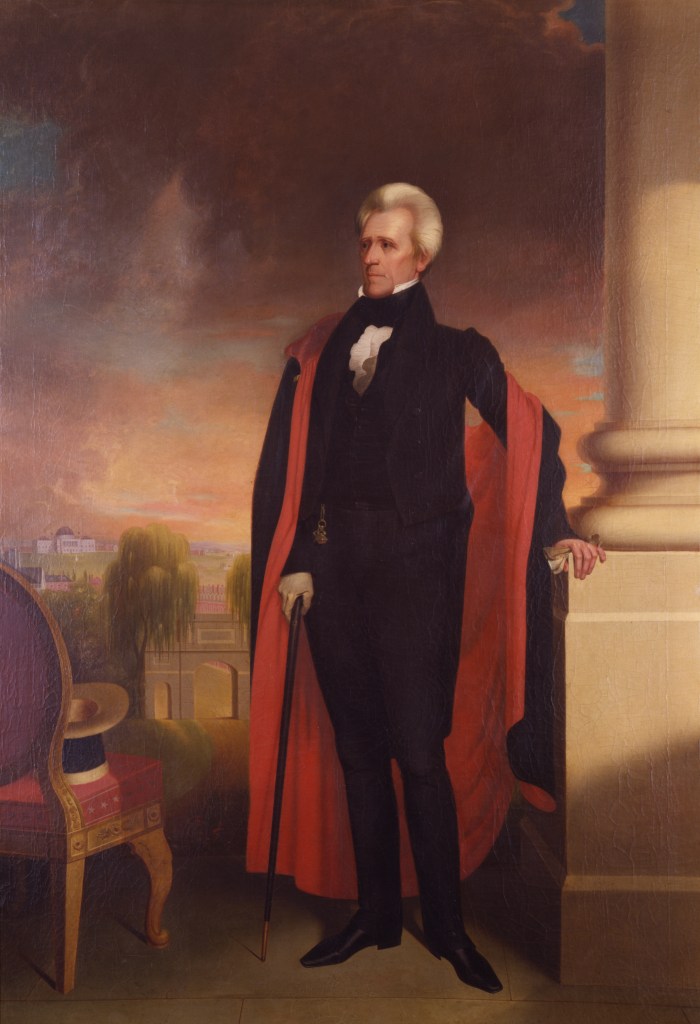
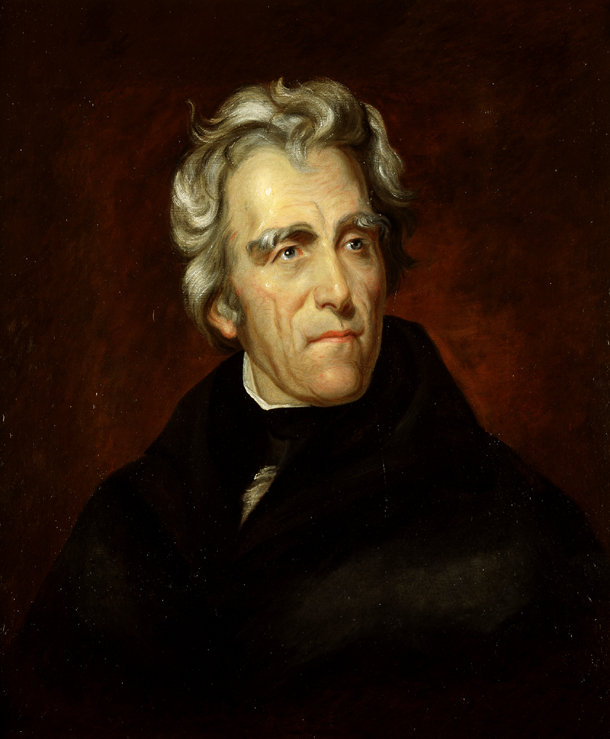
For Presidents’ Day 2022, I want to dedicate some few words to one of the greatest figures of American history – Andrew Jackson. Known at times as Old Hickory, The Hero of New Orleans, or even King Andrew, Jackson was impressive enough to define and epitomize an era, sometimes called the “Age of Jackson.” As a war veteran, Indian fighter, militia leader, lawyer, congressman, senator, president, the man who ended the national bank cartel, and founder of a political party, Jackson’s achievements and influence could be put up against anyone’s. I honor this American hero as one of the best leaders and firmest patriots who ever trod our blessed soil. 

Andrew Jackson was born to Irish immigrants in South Carolina on March 15, 1767. His father died that same year and never saw the son who was named after him. Jackson had two older brothers and was raised by his mom. They lived in poverty in the rough backwoods. A statement from a book published in 1900 gives us a good starting place for contemplating this singular life that began in such modest circumstances: 

“It is doubtful, indeed, if there ever will be, until the end of the Republic itself, an end of the dispute over the place which that slender figure with the bristling hair ought to have in American history. Had Andrew Jackson any good claim to statues and monuments, to the first place in the Republic, to popularity such as no other man had enjoyed since Washington, to power such as Washington himself had never exercised? Did he prove himself worthy of the place and power he held? To answer either yes or no with assurance one must patiently examine more books than Andrew Jackson ever glanced through in his whole life. This little book would hardly contain the full titles of them all. Yet it may perhaps be large enough to let the reader see what manner of man he was concerning whom so many bitter controversies have raged. Perhaps it may serve to explain how a Scotch-Irish boy, born to the deepest obscurity and the wretchedest poverty, and blessed, apparently, with no remarkable gifts of mind or body, came to have statues carved in his honor, towns and counties and cities named for him, long books written about him, a great party organized to do his bidding, the whole country time and again divided into those who were for him and those who were against him. . . . 

“. . . he was born to the humblest circumstances in a new settlement of a new country, and that his childhood and boyhood were passed among people of little culture, whose lives were hard and bare. The boy got little education, and never was a scholar. To the day of his death, he wrote the English language with difficulty, making many errors of grammar and spelling, and spoke it with many peculiarities of pronunciation. Of other languages he knew nothing; of the great body of science, literature, and the arts he knew next to nothing. In fact, he probably got less from books than any other famous man in American history” (William Garrott Brown, Andrew Jackson, 3-4, 6). 

The War for Independence broke out when this unlearned boy from the sticks was just nine years old. His patriotic spirit was evident as a boy and he volunteered to fight the Redcoats at age thirteen. Jackson’s soldiering didn’t last long, however, and he was captured with one of his brothers. While in captivity, an event happened that demonstrates the stalwart character of this amazing man. 

The incident occurred when a British officer ordered the young Jackson to shine his boots. Jackson patently refused to kneel down and clean the boots of the enemy. Infuriated, the enemy officer slashed Jackson with a sword. Jackson partially blocked the blow, but it cut pierced his head, giving him a scar and a rage which he carried for the rest of his life. 

William Garrott Brown described the imprint this event, and Jackson’s upbringing generally, had on him for the duration of his life: 

“[H]e bore on his head the mark of a blow from the sword of a British officer whose boots he had refused to polish. No man ever lived who had a simpler human way of loving those who befriended him and of hating those who hurt him than Andrew Jackson; and surely few men ever had better excuse than he for hating the British uniform. His feeling against the British was one of the things that colored his opinions on public questions; the supreme hour of his life was the hour when, at New Orleans, he had his revenge full measure, heaped up, and running over for all that he had suffered in the Waxhaws. Scholarly historians, passing rapidly over the events of his childhood, give many pages of learned criticism to the course he took on great public questions in later years, and gravely deplore the terrible passions that swayed him when, no doubt, he should have been as deliberate and calm as they are while they review his stormy life. But for those who would rather understand than judge him it surely cannot seem a small thing that he started out in life with such a heritage of bitter memories, such a schooling in hatred, as few children were ever cursed with. Passion and revenge are wrong, of course, but the sandy-haired, pockmarked lad of the Waxhaws had better excuse than most boys for failing to learn that lesson. It is doubtful, indeed, if any one ever took the trouble to teach it him. One little thing that stuck in his mind probably hurt worse than the sabre cut on his head. He did not even know where his mother’s grave was” (Brown, Andrew Jackson, 9-10). 

Jackson’s diehard opposition to the British is something that I respect about the man. In 2018, while everyone was fawning over the “royal wedding” of Prince Harry and Meghan Markle, I wrote an article titled “Royal Sycophancy.” In it, I expressed a thought I don’t doubt General Jackson would’ve agreed with: 

“It was against elitists who fancied themselves “royalty” that our patriot forefathers fought. American blood was spilled because the British Royal Family wanted to keep us in chains. The War of 1812 was waged for the same reason and by the same forces of evil. 

“It was against this same clique of elitists inside the United States that Thomas Jefferson, James Madison, Andrew Jackson, and others battled on the monumental issue of a national bank. Unfortunately, the Americans living in 1913 lost that battle and the Federal Reserve monstrosity exists as a parasite sucking the lifeblood out of this nation. 

“This same war has always been fought between the forces of Freedom and the sponsors of tyranny. Throughout history, tyranny has all too often taken the form of a monarchy, such as the British Royal Family represents. These monarchies, led by self-professed demigods and self-absorbed elitists, have done little more than oppress mankind, stifle growth, and impede the course of Freedom.” 

For most of his life, Andrew Jackson was compelled to fight against the British or British-sponsored forces. The War for Independence, the War of 1812, and various Indian wars were all brought about by the British tyrants. Jackson rightfully resented them. But before we talk more of politics, which will be the focus today, I want to quote some intriguing lines about Jackson’s appearance and personality from an old text I found: 

“He was far from handsome. His face was long, thin and fair; his forehead high and somewhat narrow; his hair, reddish-sandy in color, was exceedingly abundant, and fell down low over his forehead. The bristling hair of the ordinary portraits belongs to the latter half of his life. There was but one feature of his face that was not common-place his eyes, which were of a deep blue, and capable of blazing with great expression when he was roused. Yet, as his form seemed fine without being so, so his face, owing to the quick, direct glance of the man, and his look of eager intelligence, produced on others more than the effect of beauty. To hear the old people of Tennessee, and, particularly, the ladies, talk of him, you would think he must have been an Apollo in form and feature. 

“The truth is, this young man was gifted with that mysterious, omnipotent something, which we call A PRESENCE. He was one of those who convey to strangers the impression that they are “somebody;” who naturally, and without thinking of it, take the lead; who are invited or permitted to take it, as a matter of course. It was said of him, that if he should join a party of travelers in the wilderness, and remain with them an hour, and the party should then be attacked by Indians, he would instinctively take the command, and the company would, as instinctively, look to him for orders.  

“He was wholly formed by nature for an active career. The back of his head, where the propelling powers are said to have their seat, was very massive; perhaps, disproportionately so to the quantity of man to be propelled. A phrenologist, who had marked the smallness of his reflective faculty, along with such tremendous vital force, would have argued ill of his future, till he observed the remarkable prominence of his perceptive organs, and the full development of some portions of the upper moral region of the brain. “Here is a young fellow,” he might have said, “who will hold on if he takes hold, and go far if he sets out; but he will generally take hold of the right thing, and set out to go to the right place; but, right or wrong, he will not let go, nor turn back.” 

“He was a brave young man, without being, in the slightest degree, rash. If there ever lived a prudent man, Andrew Jackson was that individual. He dared much; but he never dared to attempt what the event showed he could not do. The reader is requested to banish from his ingenuous mind, at his earliest convenience, the notion that Jackson was a person who liked danger for its own sake, and who rushed into it without having weighed (in his own rapid way) the probable and possible consequences. He was consummately prudent. We have heard a great deal of his irascibility; and he most assuredly was an irascible man. But, observe; he seldom quite gave up the rein to his anger. His wrath was a fiery nag enough; but people who stood close to him when he was foaming and champing and pawing, could see that there was a patent curb in his bridle which the rider had a quiet but firm hold of. It was a Scotch-Irish anger. It was fierce, but never had any ill effect upon his own purposes; on the contrary, he made it serve him, sometimes, by seeming to be much more angry than he was ; a way with others of his race. “No man,” writes an intimate associate of his for forty years, “knew better than Andrew Jackson when to get into a passion and when not.” Yet, for all that, he was, sometimes, a most tinder-like and touchy fellow as we shall see. 

“This young lawyer, like most of those who had seen and felt what liberty had cost, was a very warm lover of his country. He remembered how vividly he remembered! the scenes of the recent Revolution; his mother’s sad fate, and its cause; the misery and needless death of his brother; his own painful captivity; the Waxhaw massacre; the ravaged homes of his relatives and neighbors; Tarleton’s unsparing onslaughts; and all the wild and shocking ferocities of the war, as it was waged in the border counties of North Carolina. These things made the deepest imaginable impression upon his mind. He could scarcely place other citizens upon the same level as the soldiers of the Revolution; whom he regarded as a kind of republican aristocracy, entitled, before all others, to honor and office. At this age, and long after, he cherished that intense antipathy to Great Britain which distinguished the survivors of the Revolution; some traces of which could be discerned in the less enlightened parts of the country until within these few years. In these respects, he was the most American of Americans an embodied Declaration-of-Independence the Fourth-of-July incarnate!” (James Parton, Life of Andrew Jackson, Vol. 1, 111-113) 

It’s often the case that the most influential leaders are not necessarily the most handsome or physically gifted. Instead, they have inner characteristics that propel them to greatness. Some are intelligent, others are brave, and some are persistent. And still some have a potent combination of traits that make them stand head and shoulders above their peers. Andrew Jackson was one such leader who was like an irresistible force of nature – a man who never wavered and who pursued his principles come hell or high water. 

So profound was Jackson’s influence in his day that I mark America’s decline from the final day of President Jackson’s administration. It’s been downhill for the United States since this monumental man left public service. He held the country together while he sat on the metaphorical throne. Yet, despite all that he did for his country in the Revolution, the War for 1812, as a statesman, and as a staunch supporter of the little guy, many then and now – especially the elitists – hate him and revile his name. 

Many of his contemporaries held less than savory opinions about Jackson. Even my dearest hero, Thomas Jefferson, said these famous lines in 1824: 

“I feel much alarmed at the prospect of seeing General Jackson President. He is one of the most unfit men I know of for such a place. He has had very little respect for laws and constitutions, and is, in fact, an able military chief. His passions are terrible. When I was President of the Senate, he was Senator; and he could never speak on account of the rashness of his feelings. I have seen him attempt it repeatedly, and as often choke with rage. His passions are, no doubt, cooler now; he has been much tried since I knew him, but he is a dangerous man.” 

To the genteel, refined Jefferson with his famously even temper, pleasant nature, and intellectual air, Jackson’s brash approach to life was jarring. The early Founding Fathers were great orators and calm, collected thinkers. Jackson, on the other hand, was a doer. He was impulsive at times, though more collected in his plans than most give him credit for. He was fiercely patriotic in a way most Americans today can fathom and he spilled his blood for his country, carrying the scars as reminders of his devotion. He was, whatever else you may think of him, a man who followed his conscience and did what he sincerely believed was right, no matter who else thought he was wrong. For that sincerity of soul, Jackson deserves our respect and admiration. 

I’m perhaps in the minority, but I think Jackson had a strong and able mind. His writing style far surpasses anything the average American of our day can produce. He was also wise and clever enough to understand the international banking scheme that held America in a bondage and to defeat it and drive it out of our land. He was a great tactician, both on the battlefield and in the political arena. He knew how to create a political machine and bring it to power. He was also, importantly, fit enough to know the Constitution inside and out and to honor it fiercely. 

At this point, many historians would no doubt lose control and, exasperated, ask how I can believe he ever followed the Constitution. Wasn’t he called “King Andrew” because he ruled like an autocrat? Didn’t he forcibly relocate the Indians, thus violating their rights? Didn’t he this, didn’t he that . . ? 

No matter what critics then or now say – and most of what they say are distortions and lies – Jackson, by his own words, was a staunch defender of representative government, rule of law, and the U.S. Constitution specifically. In his First Inaugural Address, President Jackson said

“As long as our Government is administered for the good of the people, and is regulated by their will; as long as it secures to us the rights of person and of property, liberty of conscience and of the press, it will be worth defending; and so long as it is worth defending a patriotic militia will cover it with an impenetrable aegis. Partial injuries and occasional mortifications we may be subjected to, but a million of armed freemen, possessed of the means of war, can never be conquered by a foreign foe. To any just system, therefore, calculated to strengthen this natural safeguard of the country I shall cheerfully lend all the aid in my power.” 

Those were his noble sentiments when he entered office and they were his feelings when he ended his second term as the nation’s chief magistrate. If anything, President Jackson was more deeply committed to America and rule of law in 1837 than in 1829. In his epic Farewell Address, President Jackson expressed his love of the Constitution, the necessity of preserving the Union under that sacred charter, and his livid disgust – with real life examples – at those who oppose constitutional laws or who attempt to take advantage of the People through unjust laws and banking practices. The utter sincerity of his words and depth of his emotions seeps through every syllable and cannot be doubted. 

It’s time to put on your best reading cap and bask in the warm fire of President Andrew Jackson’s patriotic soul as we quote at length from his Farewell Address

“We have now lived almost fifty years under the Constitution framed by the sages and patriots of the Revolution. The conflicts in which the nations of Europe were engaged during a great part of this period, the spirit in which they waged war against each other, and our intimate commercial connections with every part of the civilized world rendered it a time of much difficulty for the Government of the United States. We have had our seasons of peace and of war, with all the evils which precede or follow a state of hostility with powerful nations. We encountered these trials with our Constitution yet in its infancy, and under the disadvantages which a new and untried government must always feel when it is called upon to put forth its whole strength without the lights of experience to guide it or the weight of precedents to justify its measures. But we have passed triumphantly through all these difficulties. Our Constitution is no longer a doubtful experiment, and at the end of nearly half a century we find that it has preserved unimpaired the liberties of the people, secured the rights of property, and that our country has improved and is flourishing beyond any former example in the history of nations. . . . 

“These cheering and grateful prospects and these multiplied favors we owe, under Providence, to the adoption of the Federal Constitution. It is no longer a question whether this great country can remain happily united and flourish under our present form of government. Experience, the unerring test of all human undertakings, has shown the wisdom and foresight of those who formed it, and has proved that in the union of these States there is a sure foundation for the brightest hopes of freedom and for the happiness of the people. At every hazard and by every sacrifice this Union must be preserved. . . . 

“But in order to maintain the Union unimpaired it is absolutely necessary that the laws passed by the constituted authorities should be faithfully executed in every part of the country, and that every good citizen should at all times stand ready to put down, with the combined force of the nation, every attempt at unlawful resistance, under whatever pretext it may be made or whatever shape it may assume. Unconstitutional or oppressive laws may no doubt be passed by Congress, either from erroneous views or the want of due consideration; if they are within the reach of judicial authority, the remedy is easy and peaceful; and if, from the character of the law, it is an abuse of power not within the control of the judiciary, then free discussion and calm appeals to reason and to the justice of the people will not fail to redress the wrong. But until the law shall be declared void by the courts or repealed by Congress no individual or combination of individuals can be justified in forcibly resisting its execution. It is impossible that any government can continue to exist upon any other principles. It would cease to be a government and be unworthy of the name if it had not the power to enforce the execution of its own laws within its own sphere of action. 

“It is true that cases may be imagined disclosing such a settled purpose of usurpation and oppression on the part of the Government as would justify an appeal to arms. These, however, are extreme cases, which we have no reason to apprehend in a government where the power is in the hands of a patriotic people. And no citizen who loves his country would in any case whatever resort to forcible resistance unless he clearly saw that the time had come when a freeman should prefer death to submission; for if such a struggle is once begun, and the citizens of one section of the country arrayed in arms against those of another in doubtful conflict, let the battle result as it may, there will be an end of the Union and with it an end to the hopes of freedom. The victory of the injured would not secure to them the blessings of liberty; it would avenge their wrongs, but they would themselves share in the common ruin. 

“But the Constitution can not be maintained nor the Union preserved, in opposition to public feeling, by the mere exertion of the coercive powers confided to the General Government. The foundations must be laid in the affections of the people, in the security it gives to life, liberty, character, and property in every quarter of the country, and in the fraternal attachment which the citizens of the several States bear to one another as members of one political family, mutually contributing to promote the happiness of each other. Hence the citizens of every State should studiously avoid everything calculated to wound the sensibility or offend the just pride of the people of other States, and they should frown upon any proceedings within their own borders likely to disturb the tranquillity of their political brethren in other portions of the Union. In a country so extensive as the United States, and with pursuits so varied, the internal regulations of the several States must frequently differ from one another in important particulars, and this difference is unavoidably increased by the varying principles upon which the American colonies were originally planted–principles which had taken deep root in their social relations before the Revolution, and therefore of necessity influencing their policy since they became free and independent States. But each State has the unquestionable right to regulate its own internal concerns according to its own pleasure, and while it does not interfere with the rights of the people of other States or the rights of the Union, every State must be the sole judge of the measures proper to secure the safety of its citizens and promote their happiness; and all efforts on the part of people of other States to cast odium upon their institutions, and all measures calculated to disturb their rights of property or to put in jeopardy their peace and internal tranquillity, are in direct opposition to the spirit in which the Union was formed, and must endanger its safety. Motives of philanthropy may be assigned for this unwarrantable interference, and weak men may persuade themselves for a moment that they are laboring in the cause of humanity and asserting the rights of the human race; but everyone, upon sober reflection, will see that nothing but mischief can come from these improper assaults upon the feelings and rights of others. Rest assured that the men found busy in this work of discord are not worthy of your confidence, and deserve your strongest reprobation. . . . 

“There is, perhaps, no one of the powers conferred on the Federal Government so liable to abuse as the taxing power. The most productive and convenient sources of revenue were necessarily given to it, that it might be able to perform the important duties imposed upon it; and the taxes which it lays upon commerce being concealed from the real payer in the price of the article, they do not so readily attract the attention of the people as smaller sums demanded from them directly by the taxgatherer. But the tax imposed on goods enhances by so much the price of the commodity to the consumer, and as many of these duties are imposed on articles of necessity which are daily used by the great body of the people, the money raised by these imposts is drawn from their pockets. Congress has no right under the Constitution to take money from the people unless it is required to execute some one of the specific powers intrusted to the Government; and if they raise more than is necessary for such purposes, it is an abuse of the power of taxation, and unjust and oppressive. It may indeed happen that the revenue will sometimes exceed the amount anticipated when the taxes were laid. When, however, this is ascertained, it is easy to reduce them, and in such a case it is unquestionably the duty of the Government to reduce them, for no circumstances can justify it in assuming a power not given to it by the Constitution nor in taking away the money of the people when it is not needed for the legitimate wants of the Government. 

“Plain as these principles appear to be, you will yet find there is a constant effort to induce the General Government to go beyond the limits of its taxing power and to impose unnecessary burdens upon the people. Many powerful interests are continually at work to procure heavy duties on commerce and to swell the revenue beyond the real necessities of the public service, and the country has already felt the injurious effects of their combined influence. They succeeded in obtaining a tariff of duties bearing most oppressively on the agricultural and laboring classes of society and producing a revenue that could not be usefully employed within the range of the powers conferred upon Congress, and in order to fasten upon the people this unjust and unequal system of taxation extravagant schemes of internal improvement were got up in various quarters to squander the money and to purchase support. Thus one unconstitutional measure was intended to be upheld by another, and the abuse of the power of taxation was to be maintained by usurping the power of expending the money in internal improvements. You can not have forgotten the severe and doubtful struggle through which we passed when the executive department of the Government by its veto endeavored to arrest this prodigal scheme of injustice and to bring back the legislation of Congress to the boundaries prescribed by the Constitution. The good sense and practical judgment of the people when the subject was brought before them sustained the course of the Executive, and this plan of unconstitutional expenditures for the purposes of corrupt influence is, I trust, finally overthrown. . . . 

“. . . The Constitution of the United States unquestionably intended to secure to the people a circulating medium of gold and silver. But the establishment of a national bank by Congress, with the privilege of issuing paper money receivable in the payment of the public dues, and the unfortunate course of legislation in the several States upon the same subject, drove from general circulation the constitutional currency and substituted one of paper in its place. 

“It was not easy for men engaged in the ordinary pursuits of business, whose attention had not been particularly drawn to the subject, to foresee all the consequences of a currency exclusively of paper, and we ought not on that account to be surprised at the facility with which laws were obtained to carry into effect the paper system. Honest and even enlightened men are sometimes misled by the specious and plausible statements of the designing. But experience has now proved the mischiefs and dangers of a paper currency, and it rests with you to determine whether the proper remedy shall be applied. 

“The paper system being founded on public confidence and having of itself no intrinsic value, it is liable to great and sudden fluctuations, thereby rendering property insecure and the wages of labor unsteady and uncertain. The corporations which create the paper money can not be relied upon to keep the circulating medium uniform in amount . . . Nor does the evil stop here. These ebbs and flows in the currency and these indiscreet extensions of credit naturally engender a spirit of speculation injurious to the habits and character of the people. We have already seen its effects in the wild spirit of speculation in the public lands and various kinds of stock which within the last year or two seized upon such a multitude of our citizens and threatened to pervade all classes of society and to withdraw their attention from the sober pursuits of honest industry. It is not by encouraging this spirit that we shall best preserve public virtue and promote the true interests of our country; but if your currency continues as exclusively paper as it now is, it will foster this eager desire to amass wealth without labor; it will multiply the number of dependents on bank accommodations and bank favors; the temptation to obtain money at any sacrifice will become stronger and stronger, and inevitably lead to corruption, which will find its way into your public councils and destroy at no distant day the purity of your Government.” 

Sadly, President Jackson was prophetically correct. He foretold precisely how the American government would become corrupted and how our glorious free enterprise system would be turned into crass corporatism and self-centered materialism. But he was also correct that the Constitution, if obeyed to the letter, provides security for the nation and protection for individual rights. It was not fools, but sages who crafted the Constitution. And if we implement it and follow it again, we may again flourish like our countrymen in the early Republic and in the days of Jackson. 

A contemporary of Andrew Jackson, the religious leader Joseph Smith about whom I wrote an article, considered President Jackson an “august patriot” whose administration was “the acme of American glory, liberty, and prosperity.” It’s hard to dispute that description when you consider the achievements and growth of the Jacksonian era. President Jackson was the only president in U.S. history to pay off the national debt completely. He closed down the insidious, foreign-owned “national” banking cartel which was strangling the country. He presided over a booming economy. And two states were admitted to the Union – Arkansas and Michigan. 

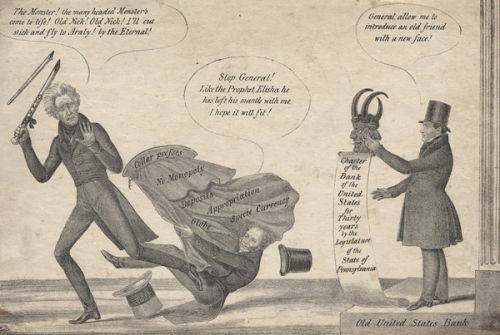
By far, Jackson’s most prestigious and important accomplishment was putting the national bank out of commission. It’s reported by author Thomas J. Dilorenzo on page 29 of his Hamilton’s Curse that President Jackson, freshly sworn in as president, referred to the national bank as: 

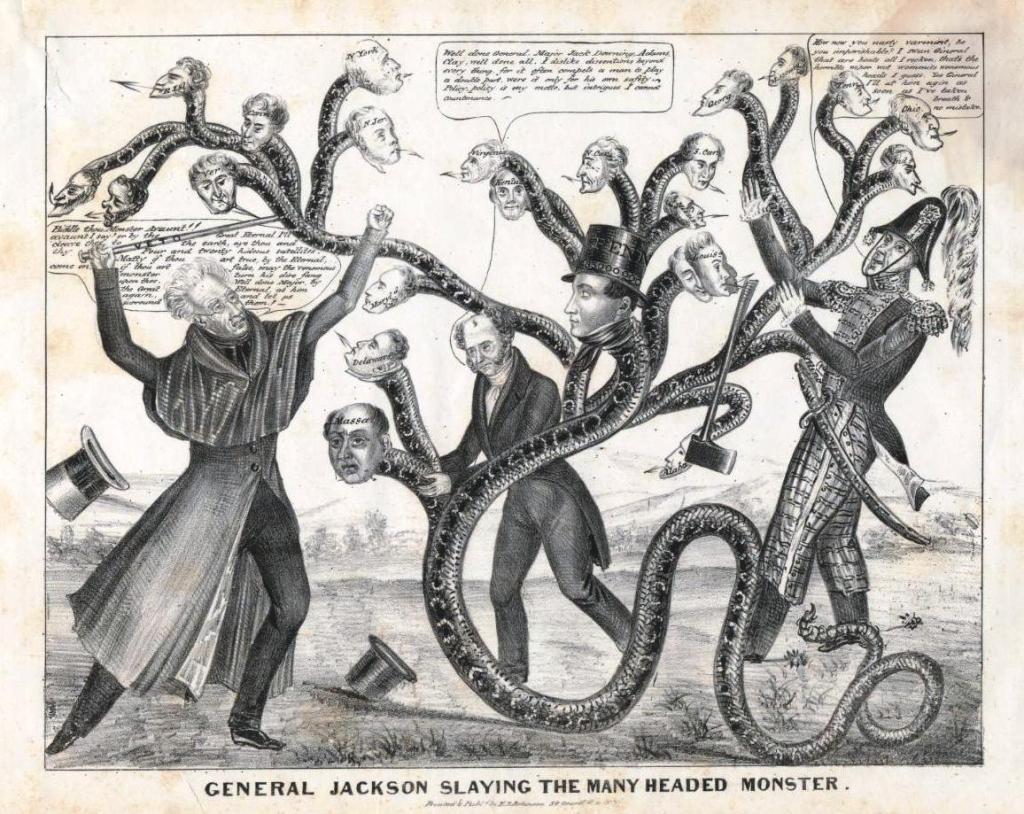
“[A] monster, a hydra-headed monster . . . equipped with horns, hoofs, and tail so dangerous that it impaired the morals of our people, corrupted our statesmen, and threatened our liberty. It bought up members of Congress by the Dozen . . . subverted the electoral process, and sought to destroy our republican institutions.” 

Throughout his presidency, Jackson battled the bank and its ruthless head, Nicholas Biddle. In his strange, but sometimes enlightening book, The Suppressed History of American Banking, Xaviant Haze recorded the sparring between Jackson and the Biddle: 

“On July 4, 1832, Congress passed a bill to extend the central banking charter another fifteen years. To Jackson the bill’s timing on a much celebrated day confirmed his suspicions about the Second Bank deliberately interfering in the political process. His nemesis Nicholas Biddle backed Henry Clay, who had helped to get the recharter passed. Biddle, via the central bank, poured more than three million dollars into Clay’s election campaign; a mind-boggling sum for those times. But Jackson vetoed the recharter and made it known to the public that the majority owners of the bank were in fact foreign (Rothschild) stockholders. Jackson warned in a letter to the Senate on July 10, 1832, that “if we must have a bank, it should be purely American.” This fiery letter to Congress, Biddle, and the American people broke down the pitfalls and realities of the central banking/Federal Reserve system. . . . 

“In all of the other presidential campaign messages, inaugurals, annuals, and vetoes that had come before, there had been nothing like this. This was an unfiltered warning to the American people about the dangers lurking in their own government, which had been corrupted and infiltrated by foreign investors. Biddle threatened that Jackson would pay for making the Second Bank a party question and published more than thirty thousand copies of his Veto Message, which he had distributed along Clay’s campaign trail in hopes that Jackson’s words would be seen as inflammatory, irresponsible, and capable of inciting chaos. 

“Jackson responded to this by printing brochures that compared the Veto Message to the Declaration of Independence and by calling Biddle’s institution “a gambler’s bank.” Jackson then took to the street and won over the people with fireworks, barbecues, and parades, all of which had a much more positive effect on the public than the newspapers, posters, and brochures had. Jackson then formed an allegiance with working-class farmers, mechanics, and laborers and campaigned with his slogan “Jackson and No Bank” against rich and powerful elite capitalists. In so doing he easily earned the support of the people, who reelected him president in a landslide victory, much to the dismay of Biddle and his Rothschild backers. 

“However, Jackson knew the battle with Biddle was just beginning and following his victory he told James K. Polk, “The hydra of corruption is only scorched, not dead.” He then ordered his new secretary of the Treasury, Lewis McClean, to start removing the government’s deposits from Biddle’s Second Bank and to start placing them in state banks. But McClean refused to do so and was instantly fired by Jackson, who replaced him with William J. Duane. But Duane was also a Biddle stooge and refused to comply with Jackson’s requests, and so he ended up being fired as well. It was 1833, and the bank war was on full bore as Jackson desperately sought allies to help him kick out the Rothschild-dominated Second Bank. 

“He finally got the help he needed when former attorney general Roger Taney stepped up to be secretary of the Treasury. . . . 

“On October 1, 1833, Jackson announced that federal funds would no longer be deposited in the Second Bank of the United States and instead instructed Taney to begin placing them in twenty-three various state-chartered banks. Taney, on the orders of Jackson, began withdrawing government funds from the Second Bank. To do this Jackson had the bank’s status changed so that it would no longer have any financial ties with the government. This resulted in a crippling lack of funds for the bank, which n ow was left out in the cold as Jackson took complete control of the government. . . . 

“This redistribution of money to the state banks annoyed Biddle so much that he threatened to cause a depression if the Second Bank wasn’t rechartered and the money that had been taken from it was not immediately replaced. It was game on for Biddle, who boldly declared, “This worthy President thinks that because he has scalped Indians and imprisoned Judges, he is to have his way with the Bank. He is mistaken.” The Second Bank’s president, Nicholas Biddle, began his counteroffensive by calling in loans and restricting lines of credit. A quick little financial crisis, he reasoned, would underscore the need for the central bank’s rechartering. . . . 

“. . . Biddle then put a squeeze on lending, and in the fall of 1834 the central bank announced that it wasn’t going to issue any new loans. This, of course, made for a rough Christmas that year as a nationwide recession hit the public hard. Biddle’s ego got the best of him as both Congress and the people turned against him. His actions of curtailing loans and causing panic in the business world was intended to force the rechartering of the Second Bank, but instead Biddle discredited the bank, which reinforced Jackson’s warnings of its dangerous powers. . . . 

“. . . Biddle made money so scarce that the recession turned into a depression and civil unrest began do descend upon America in the spring of 1835. This was a sight that pleased Biddle as he announced, “Nothing but widespread suffering will produce any effect on Congress. . . . Our only safety is in pursuing a steady course of firm restriction.” . . . . 

“Once again the people suffered the consequences of the bank war as Biddle made good on his threat and contracted the money supply. Blaming the depression on Jackson for withdrawing federal funds from the bank, Biddle gloated as he watched wages drop, unemployment soar, foreclosures and bankruptcies boom, and inflation skyrocket . . . Congress was assembled in an emergency meeting to discuss what to do about the depression and the disastrous bank war. 

“All they could do was muster enough votes to override Jackson’s veto so that the bank would be granted another two-decade monopoly over America’s money. But this vote couldn’t even get under way, because the governor of Pennsylvania stepped up in support of Jackson, claiming that at a dinner party he had overheard Biddle bragging about the bank’s plan to crash the economy” (Xaviant Haze, The Suppressed History of American Banking: How Big Banks Fought Jackson, Killed Lincoln and Caused the Civil War, 70, 74-75, 77-80). 

At the height of this brutal conflict, as the people began suffering directly from the bank’s disastrous policies, the most famous episode occurred. It’s no coincidence that U.S. presidents, and foreign leaders in general, who dare oppose a national bank, end up with a bullet in their head. The internationalist financiers are integral in the conspiracy of which I’ve written so much in my books and other articles. They are, in fact, central. And it was they who controlled the Second Bank of the United States and who were orchestrating, through Biddle, the war on America and on America’s first popularly-elected president, Andrew Jackson. 

I turn again to Xaviant Haze to tell the tale: 

“With the realization that the bank might not actually get rechartered, Biddle and the Rothschilds began to panic. At this point they did what they always did best – they grabbed an ace from up their sleeve. . . . 

“A good public execution was their favorite method of sending a message. But President Jackson had a sixth sense about it and declared in a letter to Vice President Van Buren, “The bank is trying to kill me – but I will kill it!” He would prove to be prophetic on both accounts. . . . 

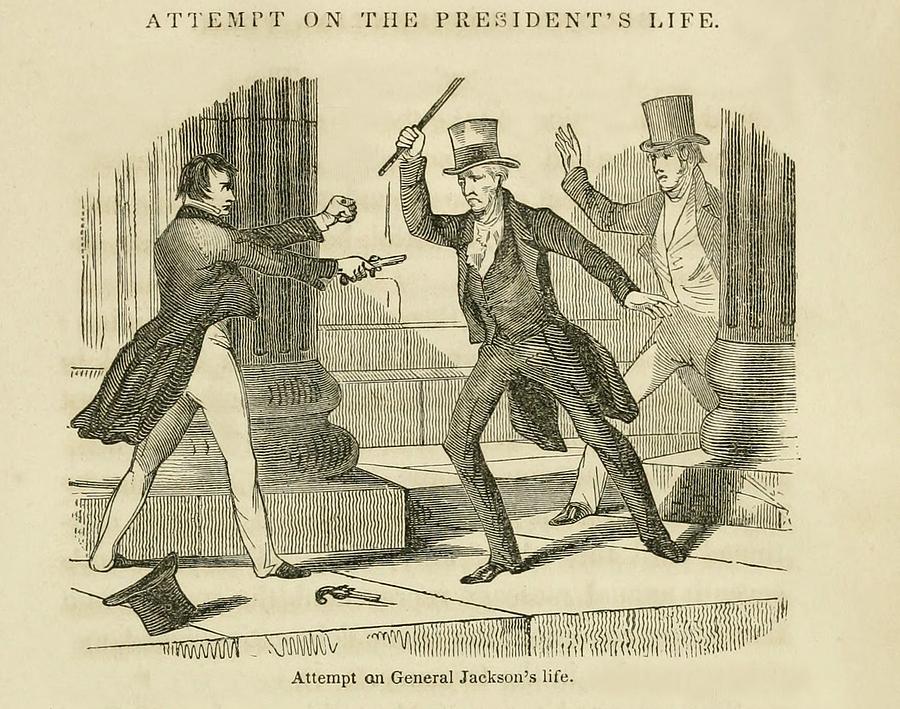
“The Rothschild family hired a mentally unstable and unemployed house painter named Richard Lawrence to do the deed. On a damp windy in 18335, Lawrence approached Jackson near the steps of the Capitol building, pulled out his pistol, and shot at him, but his gun miraculously misfired. A frantic sixty-seven-year-old Jackson confronted the befuddled would-be assassin and clubbed Lawrence to the ground with his cane. Lawrence, shielding his face with his arms and still scuffling with Jackson, managed to pull out a second loaded pistol, aiming at Jackson’s stomach. He pulled the trigger, but it also misfired. Jackson glowed as if surrounded by a mystical halo that was impervious to bullets; Lawrence was dumbfounded and was soon wrestled into submission and captured by Jackson’s aides. 

“Jackson was unharmed, surviving an assassination attempt wherein two pistols somehow managed to misfire in more than one hundred twenty-five thousand to one chance of that ever happening. Later, in true vainglorious fashion, Jackson erected a statue of himself at the site of the assassination attempt . . . Lawrence would rot away and die in the mental ward but not before admitting that powerful people from England had hired him to kill the president” (Haze, 81-83). 

Before editorializing on the assassination attempt, I want to cite one more account, by MS King in his book Andrew the Great, which I highly recommend: 

“Richard Lawrence emerged from behind a column, withdrew a pistol from his cloak, and fired it from very close range at Jackson. The cap exploded without igniting the powder in the barrel — not an uncommon occurrence with old-school pistols. Lawrence then aimed a 2nd pistol which also misfired! Jackson, still full of fight in his 68th year, charged at Lawrence with his uplifted cane, beating the would-be assassin until he could be restrained and arrested by bystanders. 

“The pistols were examined and found to be loaded. New caps were placed on them and the guns fired as designed. The President’s friends declared the miraculous double-misfires as interventions of the Almighty. Indeed, Jackson’s numerous narrow escapes through his life gave many the impressions that he was “God-protected.” The daylight public boldness of Lawrence’s attempt, coupled with the great precaution of bringing two loaded pistols, in case one might fail, was taken by many as evidence of a deep conspiracy” (MS King, Andrew the Great, 127-128). 

President Jackson was the first president to have an assassination attempt thrown at him. He won the day in a miraculous manner. I personally believe he was protected by Providence to accomplish his mission of freeing America from the grip of the bankers. In this, he succeeded. It was later generations, sadly, who couldn’t channel the dauntless spirit of Jackson and resist the schemes of the Marxist international fanciers who created the Federal Reserve private banking cartel upon us in 1913. 

Through the corrupt banking system, America has been enslaved and robbed of her wealth. We are being plunged into a massive depression currently because of the Federal Reserve’s inflationary practices and the Congress’s mind-bogglingly irresponsible spending habits. The same hydra that Jackson fought and defeated is the back and in control. Thankfully, the anecdote is the same. 

Earlier, Xaviant Haze referreneced Jackson’s letter to the Senate where he exposed the bankers’ schemes in light of the Congress’s attempt to recharter the central bank monstrosity. I want to quote a few lines from that letter which I recommend reading in full: 

“More than eight million of the stocks of this bank are held by foreigners. . . . 

“But this act does not permit competition in the purchase of this monopoly. It seems to be predicated on the erroneous idea that the present stockholders have a prescriptive right not only to the favor but to the bounty of Government. It appears that more than a fourth part of the stock is held by foreigners and the residue is held by a few hundred of our own citizens, chiefly of the richest class. For their benefit does this act exclude the whole American people from competition in the purchase of this monopoly and dispose of it for many millions less than it is worth . . . the bounty of our Government is proposed to be again bestowed on the few who have been fortunate enough to secure the stock and at this moment wield the power of the existing institution. I cannot perceive the justice or policy of this course . . . let [monopolies] not be bestowed on the subjects of a foreign government nor upon a designated and favored class of men in our own country. . . . 

“. . . If, therefore, [rechartering] shall produce distress, the fault will be its own, and it would furnish a reason against renewing a power which has been so obviously abused. But will there ever be a time when this reason will be less powerful? To acknowledge its force is to admit that the bank ought to be perpetual, and as a consequence the present stockholders and those inheriting their rights as successors to be established a privileged order, clothed both with great political power and enjoying immense pecuniary advantages from their connection with the Government . . . All the objectionable principles of the existing corporation, and most of its odious features, are retained without alleviation. . . . 

“. . . It will make the American people debtors to aliens in nearly the whole amount due to this bank, and send across the Atlantic from two to five millions of specie every year to pay the bank dividends. 

“. . . It is easy to conceive that great evils to our country and its institutions millet flow from such a concentration of power in the hands of a few men irresponsible to the people. Is there no danger to our liberty and independence in a bank that in its nature has so little to bind it to our country? . . . Should its influence become concentered, as it may under the operation of such an act as this, in the hands of a self-selected directory whose interests are identified with those of the foreign stockholders, will there not be cause to tremble for the purity of our elections in peace and for the independence of our country in war? Their power would be great whenever they might choose to exert it. 

“. . . Controlling our currency, receiving our public moneys, and holding thousands of our citizens in dependence, it would be more formidable and dangerous than the naval and military power of the enemy. . . . 

“. . . it is calculated to convert the Bank of the United States into a foreign bank, to impoverish our people in time of peace, to disseminate a foreign influence through every section of the Republic, and in wat to endanger our independence. . . . 

“Experience should teach us wisdom. Most of the difficulties our Government now encounters and most of the dangers which impend over our Union have sprung from an abandonment of the legitimate objects of Government by our national legislation, and the adoption of such principles as are embodied in this act. Many of our rich men have not been content with equal protection and equal benefits, but have besought us to make them richer by act of Congress. By attempting to gratify their desires we have in the results of our legislation arrayed section against section, interest against interest, and man against man, in a fearful commotion which threatens to shake the foundations of our Union. It is time to pause in our career to review our principles, and if possible revive that devoted patriotism and spirit of compromise which distinguished the sages of the Revolution and the fathers of our Union. If we cannot at once, in justice to interests vested under improvident legislation, make our Government what it ought to be, we can at least take a stand against all new grants of monopolies and exclusive privileges, against any prostitution of our Government to the advancement of the few at the expense of the many, in favor of compromise and gradual reform in our code of laws and system of political economy. 

“. . . In the difficulties which surround us and the dangers which threaten our institutions there is cause for neither dismay nor alarm. For relief and deliverance let us firmly rely on that kind Providence which I am sure watches with peculiar care over the destinies of our Republic . . . Through His abundant goodness and heir patriotic devotion our liberty and Union will be preserved.” 

With these sentiments and this Spartan stand against the bankers, Andrew Jackson sealed his legacy for all time. The annals of history, when history is one day properly sorted out and recounted, will hail his name and memory. The name of “Jackson” will always be celebrated by true American patriots and by all who love Freedom and hate the conniving of conspirators against humanity. God be thanked for sending Jackson and elevating him to positions of influence. 

I praise Andrew Jackson as one of the greatest presidents our Republic has ever produced. He was a man of faith, of tenacity, of sheer will. He believed in God, in the United States, in the Constitution, in the principles of the American Revolution which he proudly fought in as a thirteen-year-old son of Liberty. He loved his wife beyond all earthly things and cherished his relatives, telling them on his death bed that he would see all of them one day in Heaven. I have no doubt that’s where Old Hickory ended up and one day I hope to meet him and express my gratitude to him for fighting for America and for setting an example of statesmanship and good leadership for all generations. 

This Presidents’ Day, as America flounders under a false president who was fraudulently installed by the same international cabal that plagued our nation two centuries ago, let us turn to the great figures of our glorious past for wisdom. When we so turn, we inevitably encounter certain names that stand out from the crowd. We see Washington, Adams, Jefferson, and Madison. May I suggest that we add the name of Jackson to that list and drink deep from his well of experience. He was one of the most accomplished men in our history and one of its most popular leaders. He fought our People’s enemies – and won! We need to learn what Andrew Jackson can teach us, and quickly. God bless you and God bless America. 

Zack Strong, 
February 21, 2022

Torn Pages and Eternal Truth

Recently, my one-and-a-half-year-old daughter found my copy of the holy scriptures and tore out a page. She then ripped that page into smaller pieces. Out of curiosity, I wanted to know what message a tiny piece of holy writ, devoid of all other context, would have for me. One side of the torn piece began in the middle of a sentence, declaring: 

“. . . salvation was, and is, and is to come, in and through the atoning blood of Christ, the Lord omnipotent. 

“For the natural man is an enemy to God, and has been from the fall of Adam, and will be, forever and ever, unless he yields to the enticings of the Holy Spirit, and putteth off the natural man and becometh a saint through the atonement of Christ the Lord, and becometh as a child, submissive, meek, humble. . .” 

The list of Christlike attributes was cut off by the rip in the page. The other side of the page picked off a few verses later and neatly contained two complete verses which read: 

“And now I have spoken the words which the Lord God hath commanded me. 

“And thus saith the Lord: They shall stand as a bright testimony against this people, at the judgment day; whereof they shall be judged, every man according to his works, whether they be good, or whether they be evil.” 

I was so struck with how perfect and succinct this little sermon was that I immediately put pen to paper to share the message. It’s fitting that the first thing you read if you chance to rip a page out of the divine word is the proclamation that Jesus is the Christ and the centrality of His redemptive Atonement in the Gospel Plan. Nothing is more important in eternity than Christ’s Atonement, except, perhaps, our individual decision to accept or reject it in our lives. 

Thankfully, the prophetic word just quoted explained exactly what we can do to accept the Savior, follow Him, and become His Saints: We must listen to the Holy Spirit’s promptings and become humble, meek, and submissive like little children. This is the recipe for salvation. 

In the end, we will each be judged according to our actions, thoughts, and desires, whether they were good or evil. And those who have the prophetic record containing this powerful witness of Jesus Christ and the true points of His Gospel, will be judged according to an even higher standard. It’s a blessing to have this information so that we may look inward and correct our errors, humble ourselves, and draw closer to the Lord. 

Some may be racking their minds trying to identify the part of the Bible where the above passage is found. Which book was this little page torn from? Would it surprise you to learn that this tremendous witness of our Redeemer is not in the Bible? Instead, the passage is part of a sermon delivered by a Hebrew prophet-king named Benjamin around 124 B.C. (Mosiah 3:17-24). His sermon, and the record of numerous other holy prophets of God, is found in The Book of Mormon: Another Testament of Jesus Christ.

The resurrected Lord appearing to the Nephites in ancient America, 34 A.D.

 In 2020, I wrote an article titled “The Book of Mormon Speaks of Christ.” I encourage you to read it. I reiterate the essence of that testimony now. The Book of Mormon is and does exactly what its inspired introduction says: 

“The Book of Mormon is a volume of holy scripture comparable to the Bible. It is a record of God’s dealings with ancient inhabitants of the Americas and contains the fulness of the everlasting gospel. . . . 

“The crowning event recorded in the Book of Mormon is the personal ministry of the Lord Jesus Christ among the Nephites soon after His resurrection. It puts forth the doctrines of the gospel, outlines the plan of salvation, and tells men what they must do to gain peace in this life and eternal salvation in the life to come.” 

This is not a fairy tale. It’s not the whimsical imagination of man. It’s history. It’s truth. I witness of the veracity of The Book of Mormon, the one who brought it forth, and the Lord of whom it teaches. 

Despite the uplifting, enlightening, powerful message of Christ found in the sacred volume, Christendom flinches and recoils when the Lord offers them more of His word. Why? Why wouldn’t a Christian want to have more of Jesus’ words? Why wouldn’t they want to know more of His miracles, judgements, and revelations to holy Israelite prophets – the lost sheep He talked about during His ministry (John 10:16; see also 3 Nephi 15:12-24)? 

It’s a falsehood to claim that the Bible says there will never be more revelation or scripture. It simply doesn’t say it. It warns against adding to specific books, such as John’s Revelation and the book of Deuteronomy, but nowhere in the Bible does it say that revelation, prophets, and scripture would cease. Nowhere. That is an apostate view created by uninspired creed-followers. In fact, it is directly refuted by multiple passages, several of which I cite here and leave you to search out and ponder: Acts 2:16-21; Amos 3:7; Revelation 19:10; John 14:26

In The Book of Mormon, the Lord directly addressed those Christians who would one day reject the record and the great light it shines on Him. He said: 

“Thou fool, that shall say: A Bible, we have got a Bible, and we need no more Bible. . . . 

“Know ye not that there are more nations than one? Know ye not that I, the Lord your God, have created all men, and that I remember those who are upon the isles of the sea; and that I rule in the heavens above and in the earth beneath; and I bring forth my word unto the children of men, yea, even upon all the nations of the earth? 

“Wherefore murmur ye, because that ye shall receive more of my word? Know ye not that the testimony of two nations is a witness unto you that I am God, that I remember one nation like unto another? Wherefore, I speak the same words unto one nation like unto another. And when the two nations shall run together the testimony of the two nations shall run together also. 

“And I do this that I may prove unto many that I am the same yesterday, today, and forever; and that I speak forth my words according to mine own pleasure. And because that I have spoken one word ye need not suppose that I cannot speak another; for my work is not yet finished; neither shall it be until the end of man, neither from that time henceforth and forever. 

“Wherefore, because that ye have a Bible ye need not suppose that it contains all my words; neither need ye suppose that I have not caused more to be written. 

“For I command all men, both in the east and in the west, and in the north, and in the south, and in the islands of the sea, that they shall write the words which I speak unto them; for out of the books which shall be written I will judge the world, every man according to their works, according to that which is written. 

“For behold, I shall speak unto the Jews and they shall write it; and I shall also speak unto the Nephites and they shall write it; and I shall also speak unto the other tribes of the house of Israel, which I have led away, and they shall write it; and I shall also speak unto all nations of the earth and they shall write it” (2 Nephi 29:6-12). 

Strong words, but they are the words of the living Lord. I testify that they are true and that you will account for them one day. 

The Bible is the stick of Judah and The Book of Mormon is the stick of Joseph that the prophet Ezekiel prophesied would “become one” (Ezekiel 37:15-17).

The logic is also flawless. It is pharisaical to believe you have the only truth, or the only book, and that God can’t speak to whomever He pleases and bring forth whatever ancient or modern records He wants. He led away the lost tribes of Israel, did He not? He has also prophesied of their return, hasn’t He? How will all of that happen without continuing, modern revelation? Why did He promise to pour out visions and dreams if He didn’t intend for revelation to continue? Why would God change now when He has plainly said that He is the same yesterday, today, and forever? 

God always adapts His teachings to people in their circumstances. He gave the hosts of Israel the law of Moses because they weren’t prepared to receive His higher law. But, later, after apostasy and a period of cessation of revelation, He sent John the Baptist to prepare the way for Him. Then, He came into the world to give a higher law. When His apostles were later murdered and the churches went astray after false doctrines, another period of darkness prevailed and necessitated a Restoration – the “marvellous work” that Isaiah foretold of in the last days (Isaiah 29:14). 

We should all be able to admit that God doesn’t abandon His children. He loves them. He doesn’t cease speaking to them. He doesn’t ignore them because something He said to another group will suffice any more than parents stop teaching a younger child because they already taught it all to the older sibling. The times that revelations have stopped for a season have been times when people have embraced wickedness, rejected the Lord, and chased away the Holy Spirit. Yet, still, God continuously reveals His word through the Holy Spirit to people in all corners of the map who are humble and prepared to receive it. This is good logic. 

If you think about it, Ezra Taft Benson’s statement on revelation is pure truth: 

“God’s revelation to Adam did not instruct Noah how to build the Ark. Noah needed his own revelation. Therefore the most important prophet so far as you and I are concerned is the one living in our day and age to whom the Lord is currently revealing His will for us.” 

Who can deny this? The man to whom Christians looked for counsel in Peter’s day was Peter. He was their authorized prophet and the one to whom the Lord gave revelations and guidance. Ancient Israelites, however, looked to Moses or Isaiah or Jeremiah, depending on when they lived. The Lord always speaks through prophets, brings forth additional revelations to add upon what He has previously given, and leads His followers by the voice of His Spirit if they let Him

The problem is that Christians are like the wicked Hebrews of old who, when the Lord came down to the mountain to speak with them with His own voice, feared, distanced themselves, and “stood afar off” (Exodus 20:18-21). They could have had so much more, but they chose not to receive it. It’s the same today with people who are content to have only the Bible, rejecting both continuing prophetic revelation that adds to the scriptural canon and the personal manifestations of the Holy Spirit. 

The Lord’s words are applicable here: 

“O Jerusalem, Jerusalem, thou that killest the prophets, and stonest them which are sent unto thee, how often would I have gathered thy children together, even as a hen gathereth her chickens under her wings, and ye would not!” (Matthew 23:37

At a time when the Bible and Christian precepts are under sustained attack on every side, The Book of Mormon’s confirmation and clarification of core Biblical tenets and of the hope of victory over evil should be a breath of fresh air to Christendom. Christian disciples should rejoice that the Lord has given them another book that teaches of Him, that glorifies His name, that bolster’s the Bible’s validity, and that proclaims pure truth. I thank God from the bottom of my soul for The Book of Mormon

I know for myself through the unmistakable manifestations and power of the Holy Ghost that The Book of Mormon is true and that The Church of Jesus Christ of Latter-day Saints was divinely restored by the Lord through the instrumentality of a modern prophet, Joseph Smith. Another angel really did fly through the heavens “having the everlasting gospel to preach unto them that dwell on earth” as the Apostle John prophesied would happen preceding the Savior’s return in glory (Revelation 14:6). 

From the long-awaited Restoration in 1830 to the present, the Lord has continued to call men to serve as prophets, seers, and revelators, giving here and there His word and will to mankind. The core of what these men have taught and are teaching is found in the Bible and established, elucidated, and expanded in The Book of Mormon

I close with a serious invitation. Read The Book of Mormon. Study it. Bask in its light, which is from the Lord. Let it strengthen your faith in Jesus Christ, which is its purpose, as explained by the prophet Nephi: 

“And we talk of Christ, we rejoice in Christ, we preach of Christ, we prophesy of Christ, and we write according to our prophecies, that our children may know to what source they may look for a remission of their sins. . . . 

“And now behold, I say unto you that the right way is to believe in Christ, and deny him not; and Christ is the Holy One of Israel; wherefore ye must bow down before him, and worship him with all your might, mind, and strength, and your whole soul; and if ye do this ye shall in nowise be cast out” (2 Nephi 25:26, 29). 

Finally, I invite you to put the book’s internal challenge to pray to God for your own independent witness of its truthfulness to the test (see Moroni 10:3-5). I’ve put this challenge to the test and I have my answer from the Spirit. It’s true! It’s from God, not from the mind of Joseph Smith. It was penned by ancient Hebrew prophets who inhabited ancient America. Their stories are contained in this sacred record. Their miracles are therein recorded. Their warnings, prophecies, and counsel to us, their future readers, are precious beyond description. They were brought to light by an angel and translated by the Prophet Joseph Smith through God’s power. It truly is a “marvellous work.”  

Neither hell nor the Devil can ever make me deny my testimony of The Book of Mormon and of Jesus Christ who is the central figure of that volume. I’d be lying to myself and to my God were I to reject what the Holy Ghost has imparted to my heart. It really is true! And if this written witness of Jesus Christ and The Book of Mormon was the last testimony I ever had the chance to share, I’d be satisfied. 

Zack Strong, 
February 19, 2022

Police Need to Choose a Side 

Tyranny is impossible without the acquiescence of police. Police are where the rubber meets the road. Despots in Washington, London, Ottawa, Beijing, or Moscow can proclaim any unjust, immoral, or invasive “law” they want, but unless police choose to enforce it, it’s nothing but fluff. Police, therefore, are the ones who, on a practical level, plunge a nation into slavery or preserve its Liberty. 

Let me take one step back before moving forward. The ultimate sovereign in society is you. Do we or don’t we say “We the People”? Under our republican, constitutional system, the American People hold all political power. This is explicitly declared in The Declaration of Independence which states that government is created by the People to secure their rights and, that, when it no longer protects God-given rights, the People may “alter or . . . abolish” it. 

Though not as explicitly declared in many other nations, it is nevertheless a fact that all humans possess individual rights that no government can tamper with or revoke unless the individual forfeits them by violating the legitimate rights of others. In the final equation, if you want to know why a society flounders or flourishes, look in the mirror. If you don’t like what you see, change. 

Now, back to the police. Law enforcement officers generally take an oath when they join the force, such as this oath in the city of Phoenix: 

“I (state your name), do solemnly swear (or affirm), that I will support the Constitution of the United States, and the Constitution and laws of the State of Arizona, that I will bear true faith and allegiance to the same, and defend them against enemies, foreign and domestic, and that I will faithfully and impartially discharge, the duties of a peace officer, to the best of my ability, so help me God.” 

A police officer’s job, therefore, is to defend the rights of Americans. This is, after all, the purpose of the Constitution. The Preamble to the Constitution states: 

“We the People of the United States, in Order to form a more perfect Union, establish Justice, insure domestic Tranquility, provide for the common defence, promote the general Welfare, and secure the Blessings of Liberty to ourselves and our Posterity, do ordain and establish this Constitution for the United States of America.” 

The very job of police – the job they swear before God to perform impartially and to the best of their ability – is to “secure the Blessings of Liberty” to Americans everywhere. They have no obligation, right, or authority to enforce unconstitutional “laws,” edicts, or mandates. That’s not their job. When they enforce anything nefarious, anything unconstitutional, anything that has been foisted upon the public by fiat, they openly break their oaths and come out as enemies against the American People. 

Police don’t get their authority from some unknown, supernatural force. Rather, they get it, conditionally, as an endowment from the American People. As with the government in general, the public may abolish, reprimand, alter, decrease, or restrict the police anytime they feel like it. And that’s precisely what needs to happen because, sadly, many thousands of police have gone along with tyranny and are brazen oath-breakers. 

Think of the vicious totalitarianism the police, speaking collectively, have engaged in the past two years alone. They’ve shut down private businesses, arrested pastors, beaten peaceful protestors, dragged people off to quarantine camps, issued fines for people not wearing oxygen-inhibiting slave masks on their faces, etc. This is pure oppression. And the police who went along with it and enforced this evil are enemies of the Republic.  

Thomas Jefferson singled out government jackbooted enforcers in The Declaration of Independence. He referred to these “swarms of Officers” who “harrass our people, and eat out their substance.” He also lambasted “Standing Armies,” which is more or less what police – 700,000 strong – have become. And this is to say nothing of the hordes of ATF, IRS, DHS, FBI, and other federal mini-tyrants that harass our People. Jefferson would hammer today’s police every bit as strongly as he did the British monarchy’s swarms of officers in 1776 because they are enforcing acts of tyranny far surpassing anything inflicted upon Americans prior to our year of Independence. 

Police who go along with illegal, immoral, unconstitutional government mandates and bogus “laws” are on the wrong side of history and will be held in derision by future generations. No true American says, in a cart blanche statement, “I support the police.” I support good cops who know they’re citizens like anyone else and not above us, who aren’t pompous, who actually serve their communities, who defend their fellow countrymen against government overreach, and who stand firm by the Constitution – political pressure and public opinion be damned. 

No peace officer deserves our adulation unless he is a constitutionalist and stands against government tyranny in favor of our sacred rights. I don’t respect a badge for no reason. I only give my respect to men who use the authority I’ve lent him to defend me, defend my property, defend my family, defend my community, defend my rights. 

I don’t care one whit for any officer who says: “Just doing my job.” No, your job is to defend the Constitution; not enforce communistic dictates that tear apart Liberty. Your duty, your sworn duty, is to stand in the gap between the citizenry and the wolves in sheep’s clothing who would attempt to use the power of government to oppress the People. If you’re doing anything else, you’re a failure and should hand in your badge and go your way in disgrace. 

Not much more needs to be said. Police need to choose a side. They need to choose to stand with the American People and protect their God-given rights against corrupt government. If they don’t, they side with the enemy by default. If they won’t stand by us, they’re not “heroes.” If they won’t stand against illegal mandates and top-down tyranny and defend We the People, they’re despots. 

Police officers of America, know this: If you enforce tyrannical orders for any reason, you’ve chosen your side and deserve your eternal infamy. Don’t mark yourself as an enemy of the Republic and humanity. Stand up for Freedom, defend the Constitution, and wear out your life in the cause of God-given rights – as you swore to do when you put on your badge. 

Zack Strong 
February 16, 2022