“Good Samaritan Law? I never heard of it. You don’t have to help anybody; That’s what this country’s all about. That’s deplorable. Unfathomable. Improbable.” – Jackie Chiles, Seinfeld
A city is not a community. A group of people living together is not a community. A cluster of houses in a common location is not a community. A political jurisdiction on a map is not a community. What, then, is a community?
I have lived in big cities with millions of inhabitants, medium-sized cities, tiny towns, and even remote villages. I have lived abroad in Russia and Panama and in many varied locations in the United States including Idaho, Washington, Arizona, Wyoming, Alaska, Utah, and Hawaii. In the rural villages and towns in several of these states, I learned the true meaning of “community.”
My first real introduction to “community” was when I lived in picturesque Port Lions, Alaska, as a teenager. When I lived there, the population was around 200. In the theme song of the popular 80s show Cheers, we hear the memorable line: “Sometimes you wanna go where everybody knows your name.” Port Lions is a place where “everybody knows your name” and you know theirs.
In Port Lions, not only did you know everyone’s name, but you could often identify who was driving past your house by the sound of their vehicle. You saw the same people at school, at the post office, on the five miles of unpaved roads, at the airstrip, at the harbor, at the dock, at the dump, on the ferry, and in the woods.
When you needed help, they were there. When you wanted to talk, they were there. When you wanted to throw a party, they were there. When you needed advice, they were there. When you were sick and needed a meal delivered to your house, they were there. When your car broke down and needed a hand, they were there. When your car went into the ditch, they were there. When school kids won in sports, they were there. When they lost in sports, they were there, too. They were always there.
George Washington gave what to me is the keenest definition of “friendship” I’ve ever heard. It applies to our discussion of “community.” Said he:
“Be courteous to all, but intimate with few, and let those few be well tried before you give them your confidence? True friendship is a plant of slow growth, and must undergo & withstand the shocks of adversity before it is entitled to the appellation” (George Washington to Bushrod Washington, January 15, 1783).
Communities are like true friends – they stick together through thick and thin, black and blue, rain and shine. In Port Lions, we stuck together and faced challenges as a unit. One small example helps to illustrate. Kodiak Island, where Port Lions is located, is home to one of the largest bears on the planet – the Kodiak brown bear. Problems with these bears were rare. In fact, it was common for people to go to the local landfill and watch bears lumber out of the woods, tear through trash, and drag whatever morsels they found back into the forest. Our version of a drive-in theater.
If the bears happened to enter the community, however, the phone lines lit up as everyone called everyone else to warn them and to make sure everyone was safe. Would this, or even could this, happen in a big city?
It was especially true that my family stuck together during our years in Port Lions. My family became more closely-knit than ever before. We started the day together at home. We then went to school together (my Dad is a teacher and my Mom began working as an aide when my youngest sibling began attending school). My Dad was my coach in the afternoon. My family saw each other in the evening for dinner, scripture study, relaxation time, etc. On Sundays, we also had Church in the home – all three hours of it each week. Nothing could have welded our family more closely together than living in Port Lions. For that fact alone, I consider Port Lions the best place I have ever lived and thank God with all my heart for the opportunity I had to live there.
A view of Port Lions on a nice spring say looking across the Causeway.
In Idaho, which is my home state, I have lived thrice in towns of 600 people or fewer and will soon move to Idaho City which fits the same bill: Grandview; Bancroft; and Weippe. In the latter two specifically, the sense of community was alive and well.
I moved to Weippe in 2014 after having lived for several years in a medium-sized metro area. That particular metropolitan area in Utah is ranked as one of the safest in the nation and is a place where crazy things don’t generally happen. Even so, the difference was stark. No matter how safe or friendly a city is, it can never compare to the closeness and camaraderie you feel in a small community where everyone knows everyone else and associates with them in-person on a regular basis. That’s just not possible in a metro area of 300,000. Most of the people you meet daily will be complete strangers and, though nice they may be, you’ll feel no personal connection with them.
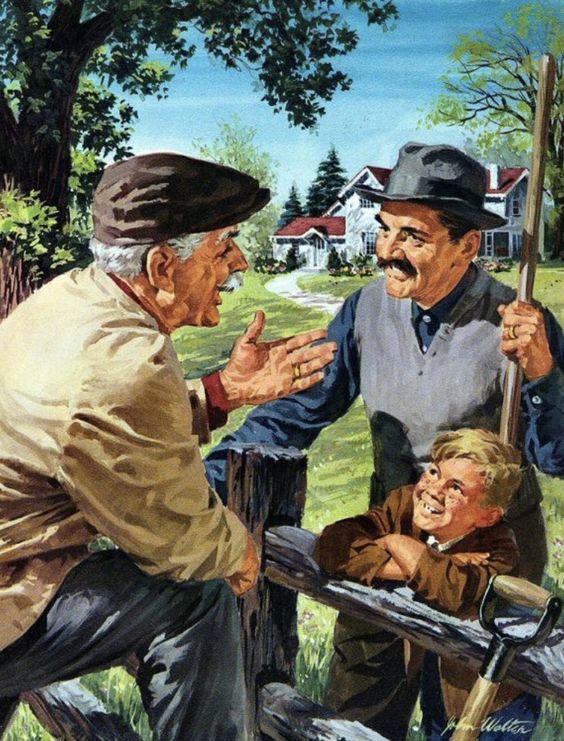
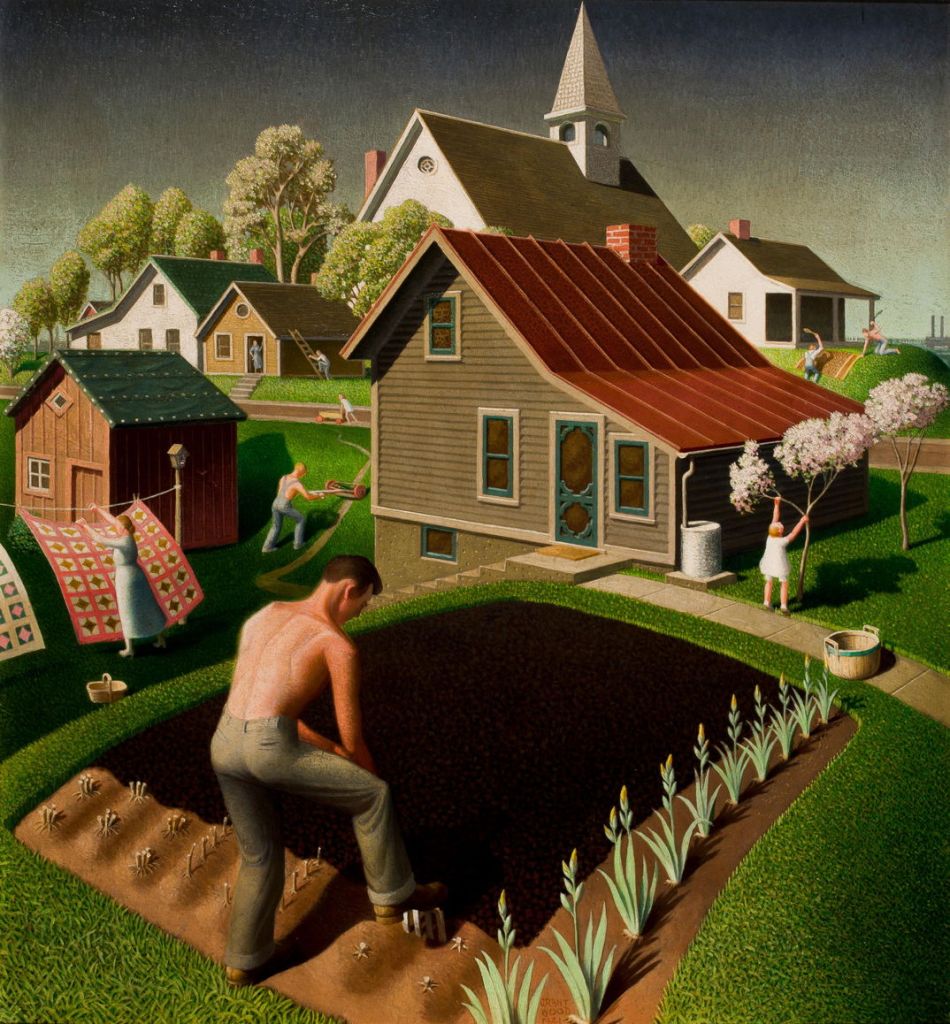
In Bancroft, Idaho, community spirit was also reality. Members of the biggest local church chopped wood for people to burn in the winters. We had a great event each year where we lit the Christmas lights, enjoyed food and live music, and welcomed Santa Claus with cheers. I loved my daily trips to the post office because I had the chance speak with the wonderful postal woman Pam. People knew your name and would greet you with a smile or wave at you on the road. You could even stop your car on the road and talk window-to-window with other drivers. You had the time – there were no traffic jams. The atmosphere was simply different.
Name a city anyone on earth where you can regularly enjoy the same benefits I’ve described. I don’t know one. I’ve never been in one. Yes, there may be individual neighborhoods within cities where everyone is close, everyone helps each other, and everyone associates regularly. However, I know of no city on earth where that same situation, closeness, friendliness, and intimacy prevail.
Instead, cities are toxic, both literally and figuratively. Cities are often polluted, dirty, trashy, rundown, full of litter, littered with homeless people and drugged-up wrecks of humanity, drab and dingy, industrial and cold, shapeless and bland, etc. There is greater division, cliquishness, anger, and stress; higher prices, more disease, more crime, and greater tragedies. True, I’m generalizing. Some cities have bright colors, nice sights, beautiful parks, etc. Some are also relatively happy or peaceful and don’t have much violent crime. But, as a generalization, cities are dreary, drab, cold, unfeeling, and more unsafe. We call them “concrete jungles” for a reason.
When you confront people about the toxicity of their city, however, they often recoil and get angry or defensive. Yet, if they’re honest, they will admit that large cities are not conducive to community, oneness, unity, intimacy, or geniality. Sinead Mulhern wrote an interesting op-ed about her experience with Toronto, Canada, compared with her experience in Cuenca, Ecuador. She wrote of arriving in Cuenca and being invited to a party, saying:
“I’d arrived in Cuenca two months before, and this was just the latest example of the city’s friendliness—a stark contrast to the life I’d left behind in Toronto. Here, hellos didn’t come with an arm’s-length handshake but rather with a hug and a kiss on the cheek. Strangers always asked me about myself. Neighbours offered rides in their cars. My landlady never failed to ask about my afternoon run. When I left Toronto after living there for eight years, I wasn’t sure what I was looking for. But here was the answer: community.
“That’s something I didn’t have at home—and, it turns out, I wasn’t the only one. Scientists and world leaders are starting to refer to a loneliness “epidemic.” The New York Times reports that about half of Americans reported feeling lonely—and 13 percent say no one in their life knows them well. And in the U.K., the problem was bad enough that then-Prime Minister Theresa May appointed the world’s first Minister for Loneliness in January 2018. Here at home, 28 percent of Canadians now live alone, which is the highest number on record and a risk factor for loneliness.
“All of this social isolation can have a real impact on our health. A 2015 study out of Brigham Young University found loneliness was as big a risk factor for early death as smoking 15 cigarettes a day, making it a bigger health risk than obesity and a sedentary lifestyle. And, according to the U.S. National Institute on Aging, research has linked social isolation to other ailments, like high blood pressure, heart disease, anxiety, depression and even Alzheimer’s disease.
“When I lived in Toronto, I never realized how lonely I was. I’d moved to the city for school and stayed after I graduated, but as the friends I’d made moved away, I was left with a gaping hole that I tried, unsuccessfully, to fill. I swiped right and became familiar with the communication cop-out that is ghosting. I went to parties with seemingly impenetrable Toronto cliques and felt like a permanent fringe friend. I did have meaningful friendships, but in my experience, Toronto is a place where community ranks lower than one’s job, relationship and personal commitments.”
I’ve spoken with many people who have expressed nearly identical views and experiences. They feel, on a gut level, that someone isn’t right about cities. It’s not how humans are supposed to live. We’re not supposed to be nameless faces in a crowd; a cog in a giant machine. Rather, we’re supposed to be unique individuals in a community of individuals working voluntarily together for their collective good and the betterment of the whole. While perhaps not impossible to achieve in cities, it is nearly so.
Cities simultaneously promote collectivism and extreme individualism. I’ve always been a supporter of individualism. However, there are limits. Thomas Jefferson referred to “rightful liberty,” for instance, and said that “rightful liberty is unobstructed action according to our will, within the limits drawn around us by the equal rights of others. I do not add ‘within the limits of the law’; because law is often but the tyrant’s will, and always so when it violates the right of an individual” (Thomas Jefferson to Isaac H. Tiffany, April 4, 1819).
Individual rights, agency, and accountability are paramount; yet they must be circumscribed by the rights of other people and the general welfare of the community. This is not collectivism, but rightful individualism. Collectivism says that the community is more important than the individual and it does the very thing Jefferson warned about but in reverse – it restricts rightful Liberty and violates the rights of individuals to promote an undefinable mass called “community.”
Collectivism is not “community” in the sense I’m using the term today. It is an aberration of my idea. My idea of community is a unit, team, or group of people who harmoniously exercise their individual rights to promote a better life for everyone. No one steps on anyone’s toes. No one elevates themselves at the expense of others. No group has legal advantage over another. All are on the same level and enjoy the same rights, but willingly and voluntarily use their personal agency to assist others, work with them, and form a stronger unit.
It’s impossible to read the holy scriptures without encountering the Son of God saying that we should be “one.” He was not a Marxist. He was not a collectivist. Yet, He desired us to be one in spirit, in ideals, in willingness to help, in purpose, in mission, in compassion, and in every other good and wholesome way. He never envisioned us to be “one” mass of humanity with no individualism. Rather, His Gospel speaks of individuals being rewarded, or punished, for their own individual acts. He told parables of individuals using their unique gifts and talents wisely to expand what He gave them and to do the most good possible for others.
Community, really, is about connections. It’s connecting with other people. It’s becoming one with them, not in substance but in purpose, ideals, and goals. Early Americans had many divisions, but their goals and principles were nearly identical. They merely squabbled about how best to implement their shared vision. Having a shared vision that individuals join up with others to reach is what makes a community.
Merriam-Webster’s dictionary gives many definitions of “community,” but its basic definition states that a community is “a unified body of individuals.” I believe this is apt. Like in Port Lions, Weippe, or Bancroft, a community is not merely a political or geographical jurisdiction, but a group of people voluntarily uniting in the spirit of unity and shared interest. They don’t have to help each other, but they do. They don’t have to come together for events and service projects, but they do. They don’t have to support the local sports teams and schools and churches, but they do. They don’t have to help others move into or out of the town and shower them with food and support in hard times, but they do.
In cities, we become faceless, unnamed parts of a faceless, unnamed mass; proudly trumpeting our individuality while actually lacking both individuality and the connections with others that make a true “community.” We effectively disappear. We become consumed in the mass of humanity from whom we are paradoxically disconnected.
In cities, we may have certain connections, friends, and acquaintances, but rarely do we connect with passersby and strangers. Our primary interactions with other human beings are with strangers who don’t know us, who don’t want to know us, and who won’t be there for you when things get tough; nor will you be there for them when they need support.
We may have our own small “communities” within the larger population, but our cities lack community spirit and oneness and don’t operate as cohesive units. Each of these tribal “communities” wars against the other in a competitive manner, cementing divisions and buildings walls where there should be bridges.
This depressing disconnectedness and tribalistic divisiveness have only been exasperated over the past several years as a result of insane COVID tyranny. “Social distancing,” which is medically unsound advice, inflamed loneliness, depression, mental illness, bitterness, anger, self-isolation, and other feelings that don’t benefit or better communities, let alone individuals. Jack Langley at America’s Future published an article talking about the negative changes that have swept the globe in the wake Coronahoax tyranny. He wrote:
“It is inherent to human nature, and particularly to American culture, that we feel the need to be a part of something bigger than ourselves and experience. Whether that be a college, a social club, a religious institution, or even a prominent activist group. We innately feel called to be a part of something, a community of like-minded people if you will. But are we capable of feeling a part of any community if we are only interacting online? I would say it’s possible, but that it is not sustainable long term.
“Life itself is a collection of human experiences. We experience the first day of primary school as a small child, nervous and excited to finally begin education with peers. We experience the first day of college or our career, most often with an independent streak desiring greatly to find out what it is you plan on doing in the world. We innately have the desire to travel to physically experience other places, cultures, and their communities. I would argue that a collection of human experiences tied together thinly through a computer interface leaves much to be desired.
“The COVID-19 pandemic has caused the majority of Americans and quite possibly the world, to forget the importance of community. And this could really be a problem down the road. Communities are what fight back against the onslaught of problems that life hands us . . . We know that as Americans we can deal with anything as a unified group, working together.
“Unfortunately, the self-isolation caused by a global pandemic has caused the country to effectively lose its sense of community because we are simply not engaged with each other as much as we used to be. Life is terribly difficult for even the most clever of people, but is much more manageable, and far more enjoyable, if we do it with a community we trust, cherish, and genuinely enjoy being around. A sense of community is as important to the foundation of the United States as the Constitution itself.”
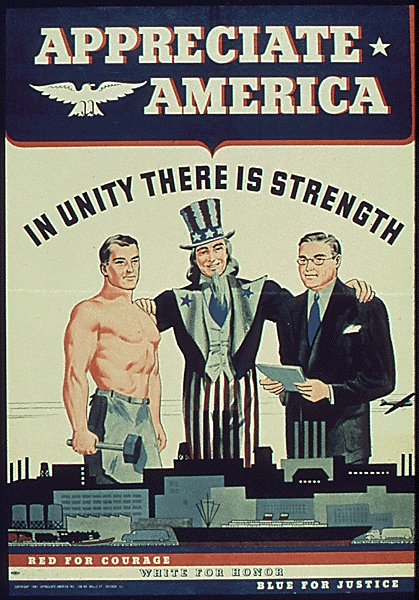
Who can disagree that having fierce community spirit was crucial in Americans achieving Independence? It was so important to our People that we named our great confederacy the UNITED States. We emphasized our oneness – our shared principles, vision, and mission as an “empire of Liberty” and a refuge for the oppressed of mankind. We enshrined rights such as the Freedom of assembly, worship, speech, and the press in our founding documents because we respected all individuals in the community and wanted each one to feel like a contributing, full member of the whole.
America was not founded as a collective mass where the majority rules and half the community doesn’t matter. We were, rather, founded as a Republic where individual states, made up of individual communities with individuals working together within them and holding equal power, came together for collective goals and to forge something great. Some of those goals were written into the Preamble to the Constitution:
“We the People of the United States, in Order to form a more perfect Union, establish Justice, insure domestic Tranquility, provide for the common defence, promote the general Welfare, and secure the Blessings of Liberty to ourselves and our Posterity, do ordain and establish this Constitution for the United States of America.”
Individuals came together in a united capacity to defend themselves, ensure their rights, perpetuate peace and the general welfare, and to enjoy the blessings of Liberty. Is not this community? It is a community of shared ideals. It is a community of principles. It is a community of individuals voluntarily linked together to do unitedly what they could not do alone. Unless America remembers her heritage, she will eventually fall.
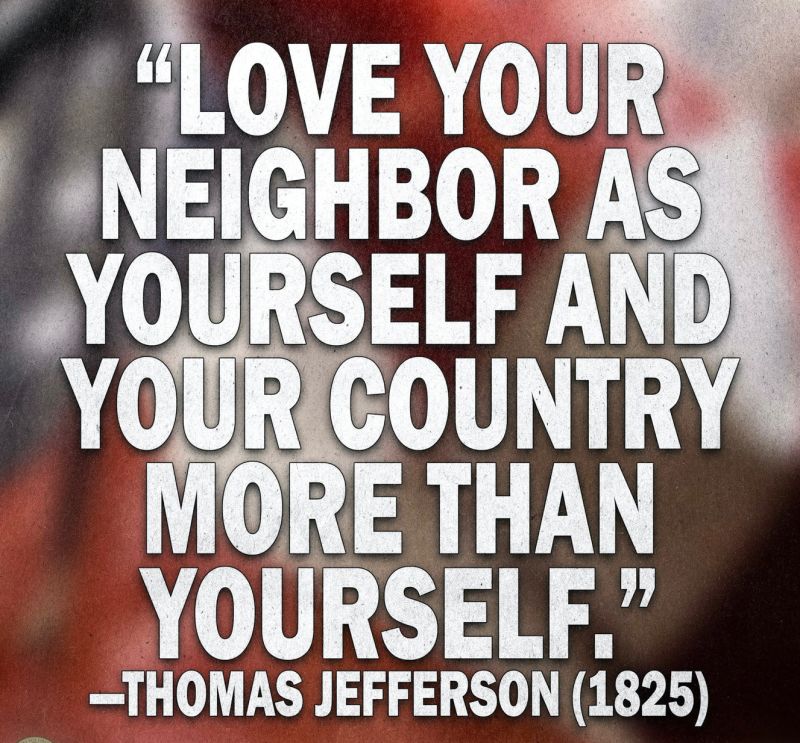
In a broader sense, unless people remember and reestablish the virtues of community, they will continue to grow apart, breed division, and devolve into disarray and tribalism. In a letter not long before his death, the percipient Thomas Jefferson gave this profound counsel:
Do we love our country more than ourselves? Do we value the community and seek to better it? Many, it seems, don’t give a hoot in hell for their country or community. They live only for themselves. In so doing, they tarnish the reputation of our republican system of individualism. People abroad often look in at the United States, see our recklessly selfish behavior, and create a perception in their heads of something that America is not.
Through my job teaching English, I have spoken with many people from Latin America who have erroneous perceptions about us. Recently, a man from Mexico asked me my opinion about my reception in Latin America versus how I’m treated in America. He was of the opinion that Latin American peoples are more open and welcoming. He thought I would readily agree. I told him that, actually, in my lifetime, I’ve experienced far more of a welcoming attitude and community spirit – true friendship, concern, and service – in the United States than in Latin America.
My friend was surprised at my response. I explained that America is seriously divided and that what is true about one part of it is not true about other parts. My part of America – rural America – is community-oriented, friendly, open, helpful, hard-working, close-knit, and kind. However, my friend was thinking of New York City and the big metropolises he sees on the news. To him, that is America. To me, that is a sad divergence from traditional American culture, spirit, and norms.
Many see America as something to exploit for their own ends; a cash cow to milk. They view things much like fictitious attorney Jackie Chiles from the hit sitcom Seinfeld. His bombastic character said: “Good Samaritan Law? I never heard of it. You don’t have to help anybody; That’s what this country’s all about. That’s deplorable. Unfathomable. Improbable.”
What’s deplorable, unfathomable, and improbable is the fact Americans have fractured their communities, divided their strength, and turned inward against each other at a time when unity is needed. We should be one nation under God, one nation united in the principles of Liberty, one nation behind the Constitution and rule of law, one nation opposed to communist barbarity, and one nation standing for Christian morality.
To restore our former station, we must rekindle the glorious bonds of community. We must keep alive the community spirit; the American community spirit. We can’t afford to become disunited and divided any more. Everyone knows that “divide and conquer” is the classic strategy to topple empires, groups, families, marriages, and friendships. At the end of the day, that nation is strongest that, while not sacrificing individual Liberty, initiative, and stewardship, is united in one in principles of goodness, service, truth, light, and community.
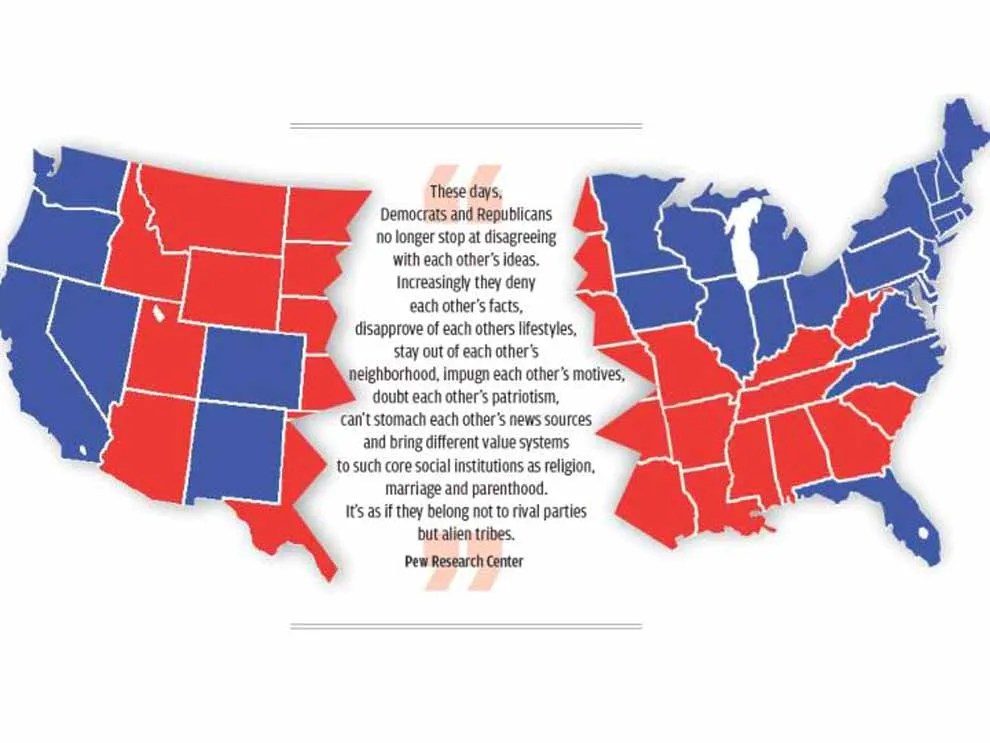
Divide and conquer – that is how we are being defeated. The name of our great confederacy is the United States of America, but we are the furthest thing from being united as a People. We are divided along religious, cultural, racial, gender, educational, economic, and linguistic lines. Instead of identifying as “Americans” first, we identify as black or white, male or female, gay or straight, Republican or Democrat, Christian or atheist, and so forth. Because we are confused about our identity, we are easily divided and sifted in other ways and are preparing for cultural collapse.
What is an African American? What is an Asian American? What is a Hispanic American? What is a European American? What is a Native American? Have you ever stopped to think how absurd these titles are? Have you ever considered how incorrect, flawed, and divisive they are?
How far do you have to reach back to determine your identity? What is the cut-off point? Not one single race in the world originally inhabited its current location. Blacks did not originate in Africa (neither did the human race). Whites did not pop up magically in what is today Europe. Asians did not sprout out of the Asian snow like daisies (bonus points if you caught the pop culture reference). American Indians were not planted in the Americas by the gods. Human migration is a fact of history and people of all races have mixed with people of all other races.
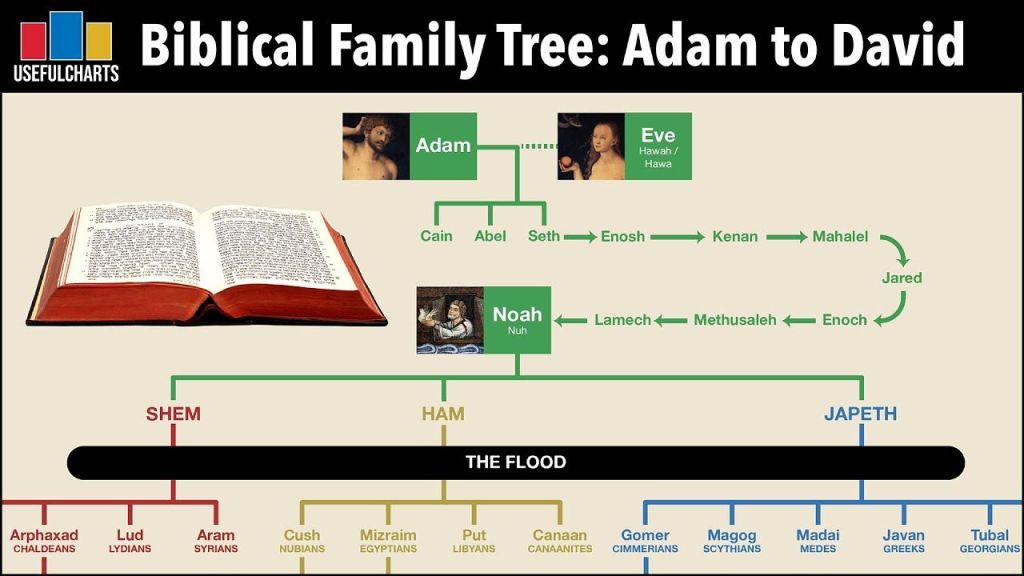
I ask again, how far do you have to go back to define yourself? If you go back far enough, you reach Adam and Eve. We are all derived from that lone man and his wife. Mankind did not evolve, as postulated Darwin and his frenzied followers who deny God, reject the scriptures, and propose an impossibly unscientific theory devoid of evidence and sense. What did evolve, however, and is not inherent in us, as our race, skin color, and other outward characteristics.
I do not suggest that race is a human construct, because there are eternal differences in people that go back beyond our birth in mortality. I also do not suggest that there are no inherent differences in what we call the various races of mankind. There most certainly are personality differences and proclivities stemming back to times in the distant past which God has seen fit not to reveal much about, though these seemingly racial differences are primarily learned differences and are determined far more by culture, religion, and tradition than by genetics. On this point, Harvard University has made some interesting observations:
“Estimating our ancestral composition down to 0.1% seem to suggest that there are exact, categorical divisions between human populations. But reality is far less simple. Compared to the general public’s enthusiasm for ancestry testing, the reaction from scientists has been considerably more lukewarm. Research indicates that the concept of “five races” does, to an extent, describe the way human populations are distributed among the continents—but the lines between races are much more blurred than ancestry testing companies would have us believe.
“A landmark 2002 study by Stanford scientists examined the question of human diversity by looking at the distribution across seven major geographical regions of 4,000 alleles. Alleles are the different “flavors” of a gene. For instance, all humans have the same genes that code for hair: the different alleles are why hair comes in all types of colors and textures.
“In the Stanford study, over 92% of alleles were found in two or more regions, and almost half of the alleles studied were present in all seven major geographical regions. The observation that the vast majority of the alleles were shared over multiple regions, or even throughout the entire world, points to the fundamental similarity of all people around the world—an idea that has been supported by many other studies.
“If separate racial or ethnic groups actually existed, we would expect to find “trademark” alleles and other genetic features that are characteristic of a single group but not present in any others. However, the 2002 Stanford study found that only 7.4% of over 4000 alleles were specific to one geographical region. Furthermore, even when region-specific alleles did appear, they only occurred in about 1% of the people from that region—hardly enough to be any kind of trademark. Thus, there is no evidence that the groups we commonly call “races” have distinct, unifying genetic identities. In fact, there is ample variation within races.
“Ultimately, there is so much ambiguity between the races, and so much variation within them, that two people of European descent may be more genetically similar to an Asian person than they are to each other. . . .
“The popular classifications of race are based chiefly on skin color, with other relevant features including height, eyes, and hair. Though these physical differences may appear, on a superficial level, to be very dramatic, they are determined by only a minute portion of the genome: we as a species have been estimated to share 99.9% of our DNA with each other. The few differences that do exist reflect differences in environments and external factors, not core biology.
“Importantly, the evolution of skin color occurred independently, and did not influence other traits such as mental abilities and behavior. In fact, science has yet to find evidence that there are genetic differences in intelligence between populations. Ultimately, while there certainly are some biological differences between different populations, these differences are few and superficial. The traits that we do share are far more profound” (Vivian Chou, “How Science and Genetics are Reshaping the Race Debate of the 21st Century”).
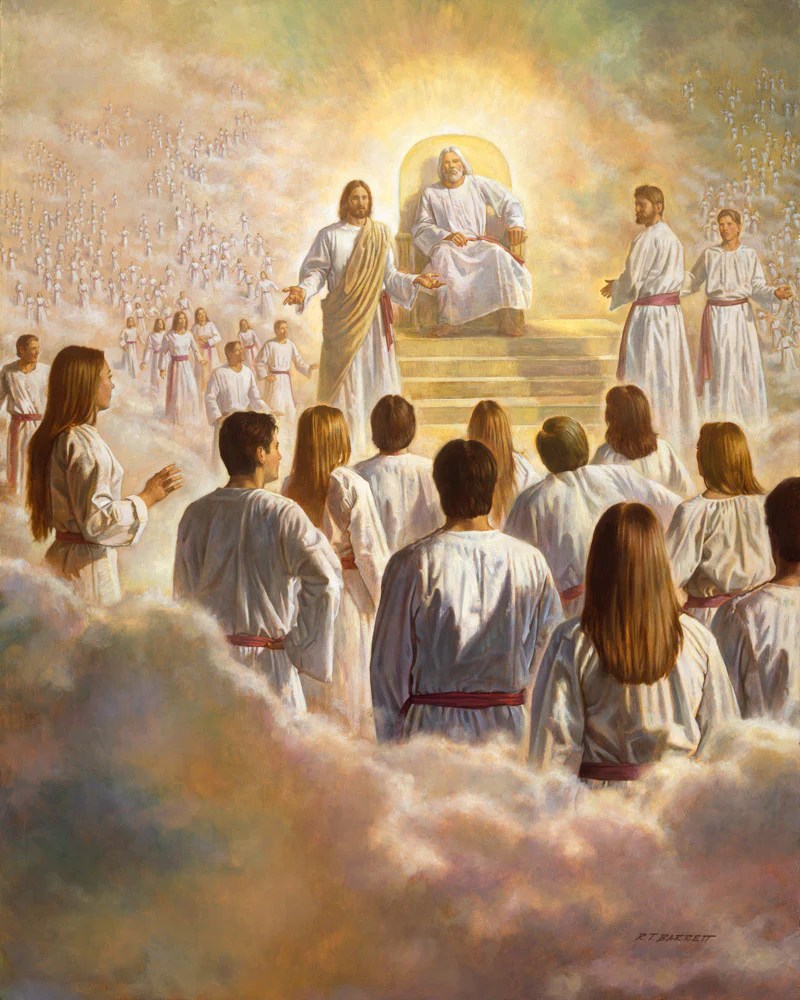
I again emphasize that there are inherent differences in people that stem back to pre-mortality, but these differences are not “racial” since we are all children of our Father in Heaven and because we all hail directly from two earthly individuals, Adam and Eve. In our pre-earth existence, we developed our various attributes, tendencies, desires, and proclivities. On earth, then, the Lord places us with other people with whom we share similar character traits, skills, and preferences. Race, then, is what is incidental – our true identities and the reasons we were born black, white, yellow, or red, go much deeper.
A modern prophet of the Lord, David O. McKay, made this detailed remark on mankind’s origin and our division into different groups:
“Revelation assures us that [the Father’s] plan antedates man’s mortal existence, extending back to man’s pre-existent state. In that pre-mortal state were “intelligences that were organized before the world was; and among all these were many of the noble and great ones; And God saw these souls that they were good, and he stood in the midst of them, and he said: These I will make my rulers; for he stood among those that were spirits, and he saw that they were good.” (Abr. 3:22-3)
“Manifestly, from this revelation, we may infer two things: first, that there were among those spirits different degrees of intelligence, varying grades of achievement, retarded and advanced spiritual attainment; second, that there were no national distinctions among those spirits such as Americans, Europeans, Asiatics, Australians, etc. Such “bounds of habitation” would have to be “determined” when the spirits entered upon their earthly existence or second estate. . . .
“. . . Songs of expectant parents come from all parts of the earth, and each little spirit is attracted to the spiritual and mortal parentage for which the spirit has prepared itself.
“Now if none of these spirits was permitted to enter mortality until they all were good and great and had become leaders, then the diversity of conditions among the children of men as we see them today would certainly seem to indicate discrimination and injustice. But if in their eagerness to take upon themselves bodies, the spirits were willing to come through any lineage for which they were worthy, or to which they were attracted, then they were given the full reward of merit, and were satisfied, yes, and even blessed.
“Accepting this theory of life, we have a reasonable explanation of existent conditions in the habitations of man. How the law of spiritual attraction works between the spirit and the expectant parents, has not been revealed, neither can finite mind fully understand. By analogy, however, we can perhaps get a glimpse of what might take place in that spirit world. In physics we refer to the law of attraction wherein some force acting mutually between particles of matter tends to draw them together and to keep them from separating. In chemistry, there is an attractive force exerted between atoms, which causes them to enter into combination. We know, too, that there is an affinity between persons – a spiritual relationship or attraction wherein individuals are either drawn towards others or repelled by others. Might it not be so in the realm of spirit – each individual attracted to the parentage for which it is prepared. Our place in this world would then be determined by our own advancement or condition in the pre-mortal state, just as our place in our future existence will be determined by what we do here in mortality.
“When, therefore, the Creator said to Abraham, and to others of his attainment, “You I will make my rulers,” there could exist no feeling of envy or of jealousy among the millions of other spirits, for those who were “good and great” were but receiving their just reward. . . .
“By the operation of some eternal law with which man is yet unfamiliar, spirits come through parentages for which they are worthy – some as Bushmen of Australia, some as Solomon Islanders, some as Americans, as Europeans, as Asiatics, etc., etc., with all the varying degrees of mentality and spirituality manifest in parents of the different races that inhabit the earth.
“Of this we may be sure, each was satisfied and happy to come through the lineage to which he or she was attracted and for which, and only which, he or she was prepared” (David O. McKay, in Jerreld Newquist, ed., Prophets, Principles, and National Survival, 499-501).
Yes, our differences are derived not from our skin color or physical place of birth on this earth, but from our pre-earth deeds, achievements, and attainment. I defy all the world to counter this truth. This doctrine is in the Bible and the various revelations of God, and one day we will have a fuller understanding of what we know in embryo now about our shared heritage – the lineage of the Gods.
Another fact is that regardless of our race or skin color, we all have unlimited potential for greatness. Each individual may, if he or she meets the terms and conditions of God’s Gospel Plan, earn a seat in the Kingdom of God. Each may, if worthy, inherit a spot at the right hand of God with their Savior Jesus Christ who makes such a destiny possible and without whom this reality is unattainable. An ancient prophet living in the Americas circa 600 B.C. declared:
“[God] doeth not anything save it be for the benefit of the world; for he loveth the world, even that he layeth down his own life that he may draw call men unto him. Wherefore, he commandeth none that they shall not partake of his salvation.
“Behold, doth he cry unto any, saying: Depart from me? Behold, I say unto you, Nay; but he saith: Come unto me all ye ends of the earth, buy milk and honey, without money and without price.
“Behold, hath he commanded any that they should depart out of the synagogues, or out of the houses of worship? Behold, I say unto you, Nay.
“Hath he commanded any that they should not partake of his salvation? Behold I say unto you, Nay; but he hath given it free for all men; and he hath commanded his people that they should persuade all men to repentance.
“Behold, hath the Lord commanded any that they should not partake of his goodness? Behold I say unto you, Nay; but all men are privileged the one like unto the other, and none are forbidden. . . .
“. . . [God] doeth that which is good among the children of men; and he doeth nothing save it be plain unto the children of men; and he inviteth them all to come unto him and partake of his goodness; and he denieth none that come unto him, black and white, bond and free, male and female; and he remembereth the heathen; and all are alike unto God, both Jew and Gentile” (2 Nephi 26:24-28, 33).
This is crystalline truth. All individuals are privileged in God’s eyes. He invites them all to come to Christ. If they come to Christ, repent, are baptized in His name by proper authority, and follow His commandments, they will all receive the same eternal reward. The resurrected Lord did not exaggerate or lie when He enjoined His disciples:
“Go ye therefore, and teach all nations, baptizing them in the name of the Father, and of the Son, and of the Holy Ghost: Teaching them to observe all things whatsoever I have commanded you” (Matthew 28:19-20).
He did not tell them to go into all nations, except India, or except the Sub-Saharan Africa, or except white Europe. He did not tell them to treat anyone differently because of superficial skin color differences, nationality origins, cultural upbringings, socio-economic status, gender, or any other factor. Rather, He invited all to come to Him and commanded His followers to teach all nations.
If the Lord commanded us to reach out to all peoples everywhere, but the prevailing opinion of our day is that we should all be divided into groups, classes, races, genders, and self-identities, then who did this idea come from? Satan. He is the Father of Lies and the source of division, contention, hatred, prejudice, and evil. If you are guilty of following his plan of division along any lines except merit, I invite you to shake off your false philosophies, repent, and heed the words of God.
I can’t express how very little it matters to me that some people will think I’m naïve for referencing scripture, citing prophets, or basing my ideas on unpopular yet revealed truth. At the end of the day, however, man-made “science,” personal opinions, and both multicultural and identarian politics, will melt away into nothingness and pure truth will remain.
The point of all of this is to show how flawed and nearsighted our self-definitions are. We divide ourselves when there is no reason for it. We overemphasize skin color and other traits that are out of our control, yet focus little on merit, worthiness, and the overarching fact that we are all children of the same God, who is our literal Father. It is an inherently Marxian practice to identify people by classes and then pit them against each other. If you look at the origin of most of the contentious self-identifying groups (LGBT, Black Lives Matter, etc.), you find that they grew out of a Judeo-Marxian mindset and were deliberately created to fuel division and break down the existing societal order.
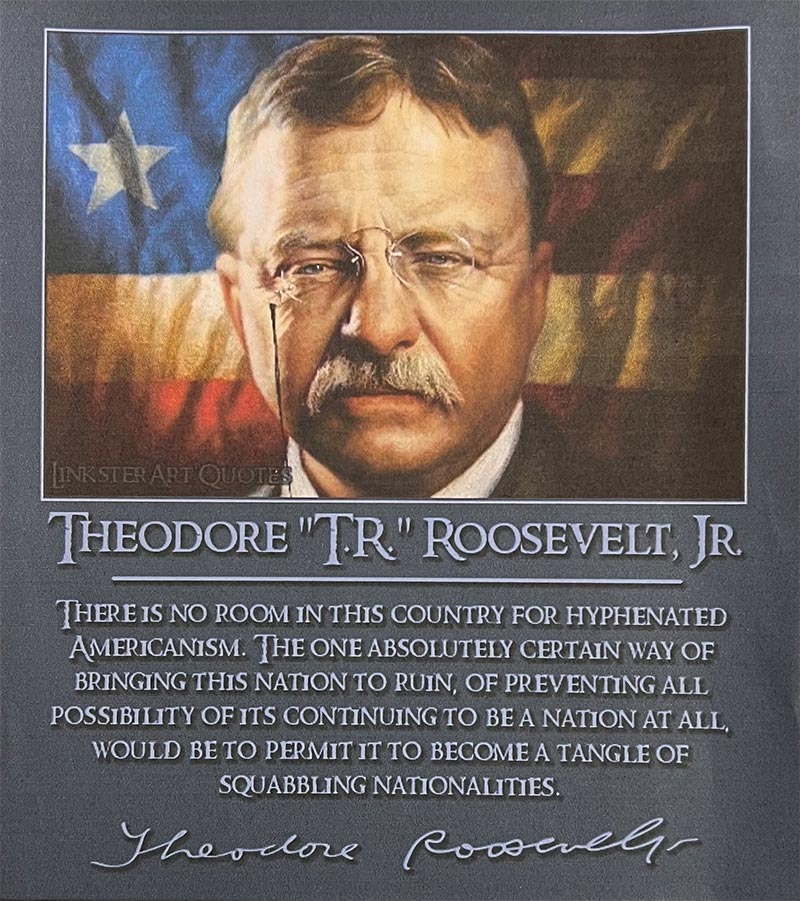
This brings us back to the title of this article: Hyphenated America. I took the title from Teddy Roosevelt. He may have been a deluded Progressive, but he was an American first. In 1915, he gave a speech called “Americanism.” It deserves to be read by all now living. In it he condemned the trend of labeling people by superficial qualities, like their nation of origin, and forgetting the unifying factors. He affirmed:
“What is true of creed is no less true of nationality. There is no room in this country for hyphenated Americanism. When I refer to hyphenated Americans, I do not refer to naturalized Americans. Some of the very best Americans I have ever known were naturalized Americans, Americans born abroad. But a hyphenated American is not an American at all. This is just as true of the man who puts “native” before the hyphen as of the man who puts German or Irish or English or French before the hyphen. Americanism is a matter of the spirit and of the soul. Our allegiance must be purely to the United States. We must unsparingly condemn any man who holds any other allegiance. But if he is heartily and singly loyal to this Republic, then no matter where he was born, he is just as good an American as anyone else.
“The one absolutely certain way of bringing this nation to ruin, of preventing all possibility of its continuing to be a nation at all, would be to permit it to become a tangle of squabbling nationalities, an intricate knot of German-Americans, Irish-Americans, English-Americans, French-Americans, Scandinavian-Americans or Italian-Americans, each preserving its separate nationality, each at heart feeling more sympathy with Europeans of that nationality, than with the other citizens of the American Republic. The men who do not become Americans and nothing else are hyphenated Americans; and there ought to be no room for them in this country. The man who calls himself an American citizen and who yet shows by his actions that he is primarily the citizen of a foreign land, plays a thoroughly mischievous part in the life of our body politic. He has no place here; and the sooner he returns to the land to which he feels his real heart-allegiance, the better it will be for every good American. There is no such thing as a hyphenated American who is a good American. The only man who is a good American is the man who is an American and nothing else.
“I appeal to history. Among the generals of Washington in the Revolutionary War were Greene, Putnam and Lee, who were of English descent; Wayne and Sullivan, who were of Irish descent; Marion, who was of French descent; Schuyler, who was of Dutch descent, and Muhlenberg and Herkemer, who were of German descent. But they were all of them Americans and nothing else, just as much as Washington. Carroll of Carrollton was a Catholic; Hancock a Protestant; Jefferson was heterodox from the standpoint of any orthodox creed; but these and all the other signers of the Declaration of Independence stood on an equality of duty and right and liberty, as Americans and nothing else. . . .
“For an American citizen to vote as a German-American, an Irish-American or an English-American is to be a traitor to American institutions; and those hyphenated Americans who terrorize American politicians by threats of the foreign vote are engaged in treason to the American Republic.”
Powerful words. They are also true. These United States united not around racial lines or because most of their ancestors had come from the various nations of Europe, but, rather, they united around principle. They shared common aspects but diverged in many others. Europeans, though they have nearly always been white-skinned, have been some of the most fractious and tribalistic people on the planet. The people of America, though they came from every nation in Europe, threw aside those differences that didn’t matter to form a new nation founded on law, ordered Liberty, and natural rights.
The French philosopher Alexis de Tocqueville, after exploring the United States in its early years, observed many things about what unified us and made us great. In part, he said:
“If we carefully examine the social and political state of America after having studied its history, we shall remain perfectly convinced that not an opinion, not a custom, not a law, I may even say not an event, is upon record which the origin of that people will not explain. The readers of this book will find the germe of all that is to follow in the present chapter, and the key to almost the whole work.
“The emigrants who came at different periods to occupy the territory now covered by the American Union, differed from each other in many respects; their aim was not the same, and they governed themselves on different principles. These men had, however, certain features in common, and they were all placed in an analogous situation. The tie of language is perhaps the strongest and most durable that can unite mankind. All the emigrants spoke the same tongue; they were all offsets from the same people. Born in a country which had been agitated for centuries by the struggles of faction, and in which all parties had been obliged in their turn to place themselves under the protection of the laws, their political education had been perfected in this rude school, and they were more conversant with the notions of right, and the principles of true freedom, than the greater part of their European contemporaries. At the period of the first emigrations, the parish system, that fruitful germe of free institutions, was deeply rooted in the habits of the English; and with it the doctrine of the sovereignty of the people had been introduced even into the bosom of the monarchy of the house of Tudor. . . .
“All the British colonies had then a great degree of similarity at the epoch of their settlement. All of them, from their first beginning, seemed destined to behold the growth, not of the aristocratic liberty of their mother-country, but of that freedom of the middle and lower orders of which the history of the world has as yet furnished no complete example. . . .
“The settlers who established themselves on the shores of New England all belonged to the more independent classes of their native country. Their union on the soil of America at once presented the singular phenomenon of a society containing neither lords nor common people, neither rich nor poor. These men possessed, in proportion to their number, a greater mass of intelligence than is to be found in any European nation of our own time. All, without a single exception, had received a good education, and many of them were known in Europe for their talents and their acquirements. The other colonies had been founded by adventurers without family; the emigrants of New England brought with them the best elements of order and morality, they landed in the desert accompanied by their wives and children. But what most especially distinguished them was the aim of their undertaking. They had not been obliged by necessity to leave their country, the social position they abandoned was one to be regretted, and their means of subsistence were certain. Nor did they cross the Atlantic to improve their situation, or to increase their wealth; the call which summoned them from the comforts of their homes was purely intellectual; and in facing the inevitable sufferings of exile, their object was the triumph of an idea.
“The emigrants, or, as they deservedly styled themselves, the pilgrims, belonged to that English sect, the austerity of whose principles had acquired for them the name of puritans. Puritanism was not merely a religious doctrine, but it corresponded in many points with the most absolute democratic and republican theories. It was this tendency which had aroused its most dangerous adversaries. Persecuted by the government of the mother-country, and disgusted by the habits of a society opposed to the rigour of their own principles, the puritans went forth to seek some rude and unfrequented part of the world, where they could live according to their own opinions, and worship God in freedom. . . .
“In England the stronghold of puritanism was in the middle classes, and it was from the middle classes that the majority of the emigrants came. The population of New England increased rapidly; and while the hierarchy of rank despotically classed the inhabitants of the mother-country, the colony continued to present the novel spectacle of a community homogeneous in all its parts. A democracy, more perfect than any which antiquity had dreamed of, started in full size and panoply from the midst of an ancient feudal society. . . .
“The remarks I have made will suffice to display the character Anglo-American civilization in its true light. It is the result (and this should be constantly present to the mind) of two distinct elements, which in other places have been in frequent hostility, but which in America have been admirably incorporated and combined with one another. I allude to the spirit of religion and the spirit of liberty.
“America Guided By Wisdom”
“The settlers of New England were at the same time ardent sectarians and daring innovators. Narrow as the limits of some of their religious opinions were, they were entirely free from political prejudices.
“Hence arose two tendencies, distinct but not opposite, which are constantly discernible in the manners as well as in the laws of the country.
“It might be imagined that men who sacrificed their friends, their family, and their native land, to a religious conviction, were absorbed in the pursuit of the intellectual advantages which they purchased at so dear a rate. The energy, however, with which they strove for the acquirements of wealth, moral enjoyment, and the comforts as well as the liberties of the world, was scarcely inferior to that with which they devoted themselves to Heaven. . . .
“These two tendencies, apparently so discrepant, are far from conflicting; they advance together, and mutually support each other.
“Religion perceives that civil liberty affords a noble exercise to the faculties of man, and that the political world is a field prepared by the Creator for the efforts of the intelligence. Contented with the freedom and the power which it enjoys in its own sphere, and with the place which it occupies, the empire of religion is never more surely established than when it reigns in the hearts of men unsupported by aught beside its native strength.
“Religion is no less the companion of liberty in all its battles and its triumphs; the cradle of its infancy, and the divine source of its claims. The safeguard of morality is religion, and morality is the best security of law as well as the surest pledge of freedom” (Alexis de Tocqueville, Democracy in America, Vol. 1, 27-29, 31-32, 35, 42-44).
There are some profound ideas acknowledged here. First, we note that the thing that unified the early settlers to America was their belief in God and devotion to His laws, as they interpreted them. Second, we see that the political laws they enacted were designed to accord with scripture and the Gospel of Jesus Christ. These two loyalties were key. One may add that families were crucial. Thus, we have the trio of values that I have personally sworn to defend – Faith, Families, and Freedom.
Alexis de Tocqueville noted that it was the settlers’ principles and beliefs, not their country of origin, skin color, or physical location that bound them together with ties of unity and strength. He noted a shared language also as being of great value, and surely it is. However, even linguistic ties are not as powerful as ideological ones.
Now, and forever, those societies that bind themselves together with their principles – especially if those principles are correct and point their souls to Jesus Christ and to human Freedom – will prosper, while those that form themselves upon other principles – whether race, skin color, or anything else – will eventually fail. America is failing precisely because we have allowed other factors to define us and nudge us toward class warfare – race, LGBT identities, economic status, etc.
When will my countrymen wake up to the awful reality that their sorrows have been deliberately caused by them following Marxists in sheep’s clothing who stoke conflict, create contention, emphasize differences rather than similarities, sew division and discord, and who salivate over the idea of a new American civil war with brother against brother, father against son, and neighbor against neighbor.
That is exactly where this is all heading – to the breakdown of the United States as a unified “nation under God” and guided by His laws and an inspired charter of Liberty. These calamities are on our doorstep. Prepare your family to whether the storm with their faith in Christ Jesus who will deliver a righteous remnant.
A righteous remnant is one that looks at first principles, cherishes truth, defends human Freedom, stands firm in the Gospel of Jesus Christ, and welcomes all of any race, nation, and background who wish to join our ranks. The bickering divisiveness, partisanism, and sectional strife must end.
Am I preaching peace at all costs? Of course not! Far from it. That would entail capitulating to the enemy, accepting that which is evil, and shaking hands with the Devil. There is no compromise with sin and wrong principles; disciples of Christ must stand uncompromisingly for the Lord’s truth and be a witness for Him at all times, in all things, and in all places. That is precisely why I reject those with whom I otherwise nearly completely agree but who make race their guiding issue and who refuse to acknowledge the importance of principles over people, parties, and partisanship.
Let me illustrate the stupidity of looking solely at skin color, ancestry, or national origin, as if one’s skin color, family tree, or place of birth gives them merit or worth in the eyes of God or any rational human being. My wife is a beautiful, brown-skinned Latina from the nation of Panama. Were you to judge her purely on her skin color, you would classify her as “other,” as an “outsider,” or as “foreign.”
Interestingly, most of her ancestors were not Panamanian or Latin. Rather, they were Europeans from France and Spain. They migrated to Panama to help build the Panama Canal barely more than a century ago. Yet, if the identarians (with whom I agree far more than not) have their way, my wife, whose blood is as European as mine, would be rejected. Yet, she stands for more American values – like closing the border to illegal immigrants, prohibiting LGBT maniacs from entering our schools, mandating the death penalty for pedophiles and rapists, rejecting feminism, safeguarding the home, and worshiping Christ – than many white, native-born “Americans.”
Can you see how idiotic, superficial, and unintelligent it is to view people through such a lens as skin color and nationality? Many of the people who promote a race-based ideology are Europeans – Europeans who are utterly oblivious to their own history. Europeans are highly mixed.
Some Europeans and Americans are of the vaunted “white nationalist” variety. I’ve never condemned so-called “white nationalism” because, as noted, I share the majority of their views and reject the controlled media’s slanderous use of the term. As all sane people are, I’m against forced and unregulated immigration that artificially mixes a society, such as the deliberate browning of the white portion of the world that we see taking place.
Societies that mix naturally over time have no problems, as formerly was the case in the United States, but ones that throw groups together too fast and without rhyme or reason have severe problems. This is mostly, though, because of the glaring disparity in understanding and culture more than about racial differences. The trend of third world hordes that bring to America socialist tendencies and a mindset of obedience to government (except to the government whose laws they are violating by sneaking into its territory) is an example of forced, artificial, and detrimental mixing.
Somalis being airlifted and transplanted by the thousands to Minnesota is another unnatural example and strains society. You can’t simply take uneducated people of different backgrounds, different cultural heritages, different educational and economic levels, different religions and morals, and, to top it off, different races, throw them together overnight, and expect peaceful, problem-free coexistence. It doesn’t work, and those who insidiously promote and fund this volatile mixture know it.
I don’t personally care one iota if my neighbor is from Somalia or Iraq, Australia or Brazil. I don’t care if their skin color is red, yellow, black, brown, or white. I naturally feel an affinity for fellow white people, as people of all races generally feel more comfortable with fellow members of their own race, but this has more to do with the fact that races often share different values and mine are more compatible with other white people’s values. But, if my neighbors are decent and sincere people who want to be in my country, who respect our laws and heritage, and who want to become “American” in principle and loyalty, welcome!
To those who would obsessively point out skin color, race, or national heritage, I might ask, what about me? My family line – the Strong family – goes back nearly four hundred years on this continent. Our ancestors are from England, Scotland, Switzerland, Germany, and beyond. Intriguingly, I am also related – on both my mother’s and father’s sides – to the Indian princess Pocahontas, as well as to a Cherokee woman. So, what should I be called? English? Scottish? Swiss? Indian? Perhaps it’s best to call me an English Scottish German Swiss Native American. I’ll settle simply for “Native American.” If, after 400 years in this land, my family can’t be called “native,” then who can?
As you no doubt sense, I’m being somewhat sarcastic, though what I said about my heritage including Indians and people of numerous nationalities is perfectly true. Does me having American Indians in my family tree change a single thing about me, my principles, my beliefs, or my defense of Americanism, America-first principles, the U.S. Constitution, or our unique American heritage? Of course not. Doest the fact that I am literally of the blood of the house of Israel through the tribe of Ephraim, as is my wife, alter anything? Does the fact that I married outside of my own race, though with a fellow Ephraimite, change anything about my values, commitment to Americanism, knowledge of right and wrong, or anything conceivable? No.
In terms of identity, I only want you to call me three things – a Christian, an Ephraimite, and an American. The rest is fluff. I’m white and very happy to promote our Western civilization’s traditional values and defend its noble institutions, because they have far surpassed those produced by any other races or nations and they are most compatible with the holy scriptures, but what does that matter in the eternal scheme of things?
I’ve met numerous non-white people who defend these same values and systems with equal fervency. I’ve chatted with people from Chile who are more adept at recognizing communism and opposing it than many white Americans. I’ve met kind and good people – true Christians – from around the world. I’ve met rational, family-oriented, good-hearted men and women from the Middle East and elsewhere who excelled many European-derived people I’ve known.
When I lived in Russia for two years as a missionary with The Church of Jesus Christ of Latter-day Saints and talked with everyone I could about God and life, I found the Muslims from Central Eurasia to be vastly more polite and willing to talk and listen than the atheists, hedonists, and fake white Orthodox Christians of Russia who are Christians-in-name-only. Though on paper I have more in common with Russians, I have far less in common with them in reality than with many other non-white peoples around the globe.
It is our principles and morals that should unify us. A statement attributed to Benjamin Franklin states: “Where Liberty dwells, there is my country.” An old Latin phrase similarly states: “Ubi libertas, ibi patria.” Who can honestly disagree?
I would not have much difficulty leaving the United States and settling elsewhere, even among people who don’t look or sound like I do, if we lacked Freedom and they possessed it. As it is, however, my years abroad have filled me with increasing anticipation for the day I will return to my blessed homeland. I love America. There is no place like her. In our degraded state, we still surpass any nation in the world in terms of our potential, greatness, beauty, resources, constitutionally guaranteed rights, and heritage of Liberty. God has watched over His land of America, it is a promised land, and He will yet rule over her and cleanse us until we are again righteous enough for Him to dwell among us.
In my article “America Needs Nationalism,” I explained the type of unity that ought to prevail throughout the world:
“The type of proud nationalism that once dominated the United States was primarily of the ideological type. America was often called an “Empire of Liberty.” This referred to the fact that the principles of Liberty were the glue that held our People together. Our unique Americanist ideology – that of limited government, checks and balances, constitutional republicanism, states rights, individual Liberty, power in the People springing from the ward level on up, free enterprise economics, and so forth – was the rallying point for all who wanted to be Americans. People of all races, religions, and backgrounds were free to join this confederacy of love for law and Liberty.
“Theoretically, this American brand of nationalistic sentiment could expand beyond borders and encompass all of humanity, binding them together in the love of Freedom. Perhaps a cross-border ideology sounds the opposite of nationalism, but in fact it’s not. Love of law and Liberty would not destroy nations and rope them into a collectivized super state. Rather, it would embolden their inherent nationalist tendencies and make them into free and independent states like the United States.
“Remember, though we are one People, the United States is a confederacy of sovereign units representing the individuals within them. Each state has its own culture, customs, geography, demographics, and so forth. But each is bound together under the principles set forth in the national Constitution and in their shared heritage of Liberty unsurpassed by any other people on earth. It is this example of ideological nationalism in action – this patriotic love of Liberty that propels a people to sacrifice to “secure the Blessings of Liberty to ourselves and our Posterity” – that America can offer to the world.
“. . . I plead with Americans of all races, faiths, and backgrounds to rally around the principles and ideologies that made the United States the greatest nation in world history. The Constitution and its sublime principles should be our standard. We should cling to the laws of God that undergird the Constitution. We must defend our Faith, Families, and Freedom at all costs from the international communist conspiracy. Join with me in rallying around principles and ideas, not parties and individuals.”
I again plead with people everywhere to humble themselves before Christ the Lord, unite with His Church, embrace His laws and doctrines, hold high the standard of Liberty as embodied in the U.S. Constitution, reject error and evil, discard false beliefs such as race-based ideologies that looks more at outward characteristics rather than on one’s principles, and seek unity with people who stand for Faith, Families, and Freedom regardless of their background, appearance, nationality, or past.
“Above Them All” by Jon McNaughton
I echo Teddy Roosevelt’s declaration – there is no room in America for hyphenated Americans. There is zero place for “African” Americans or “Hispanic” Americans or “LGBT” Americans or any of the other divisive identifiers being used today. There are only Americans and non-Americans. There are those loyal to this nation, her heritage, and her Constitution, and traitors. There are those committed to Christ’s Gospel and the universal precepts of right and wrong upon which the laws and institutions of the United States were founded, and those who are not. Those who are not deserve dignity as children of God, but they are not with us.
This should be our dividing line. We can accept people of all races and nationalities and create an Empire of Liberty, or, if you rather, the Kingdom of God. He is “no respecter of persons” (Acts 10) and neither should we be. Those who join our cause – the cause of Faith, Families, and Freedom – are our allies and friends regardless of whether they come from Sweden or Sudan, Cuba or Canada, Israel or Ireland, Japan or Germany.
Here, in the United States, seeing ourselves as Americans first is paramount, all other factors notwithstanding. If you come here from another country, or if you are from a minority group, ditch the self-identifier. You are not “African” American, you are simply an American. If you have an allegiance that you feel more strongly matches your beliefs, leave and go there. If you are a Jew (or Chrisitan, for that matter) who loves Israel more than your home soil, vacate this continent and go there to make your home. The same goes for anyone of any race, creed, and persuasion. Put America first or surrender your citizenship; and don’t come here in the first place unless you are willing to abandon your citizenship elsewhere and America as your home.
We torpedo ourselves when we divide into groups, factions, and tribes. I’m belaboring the point, but it’s crucial. The Founding Fathers talked much about unity. They did not preach “diversity makes us stronger,” because as it is interpreted today, that is not true. Forced “diversity” never strengthened anyone. But an organic admixture of Liberty-loving, moral patriots who want to call this land home does strengthen us.
I end with a quote from Thomas Paine regarding the American experiment in principle-focused brotherhood. Early America is a model for all other nations who would be free, prosperous, and united. The key is to be united for the right reasons. Paine wrote:
“The revolution of America presented in politics what was only theory in mechanics. So deeply rooted were all the governments of the old world, and so effectually had the tyranny and the antiquity of habit established itself over the mind, that no beginning could be made in Asia, Africa, or Europe, to reform the political condition of man. Freedom had been hunted round the globe; reason was considered as rebellion; and the slavery of fear had made men afraid to think. . . .
“. . . The independence of America, considered merely as a separation from England, would have been a matter but of little importance, had it not been accompanied by a revolution in the principles and practice of governments. She made a stand, not for herself only, but for the world, and looked beyond the advantages herself could receive. Even the Hessian, though hired to fight against her, may live to bless his defeat; and England, condemning the viciousness of its government, rejoice in its miscarriage.
“As America was the only spot in the political world where the principle of universal reformation could begin, so also was it the best in the natural world. An assemblage of circumstances conspired, not only to give birth, but to add gigantic maturity to its principles. The scene which that country presents to the eye of a spectator, has something in it which generates and encourages great ideas. Nature appears to him in magnitude. The mighty objects he beholds, act upon his mind by enlarging it, and he partakes of the greatness he contemplates. — Its first settlers were emigrants from different European nations, and of diversified professions of religion, retiring from the governmental persecutions of the old world, and meeting in the new, not as enemies, but as brothers. The wants which necessarily accompany the cultivation of a wilderness produced among them a state of society, which countries long harassed by the quarrels and intrigues of governments, had neglected to cherish. In such a situation man becomes what he ought. He sees his species, not with the inhuman idea of a natural enemy, but as kindred; and the example shows to the artificial world, that man must go back to Nature for information” (Thomas Paine, The Rights of Man, 13-14).
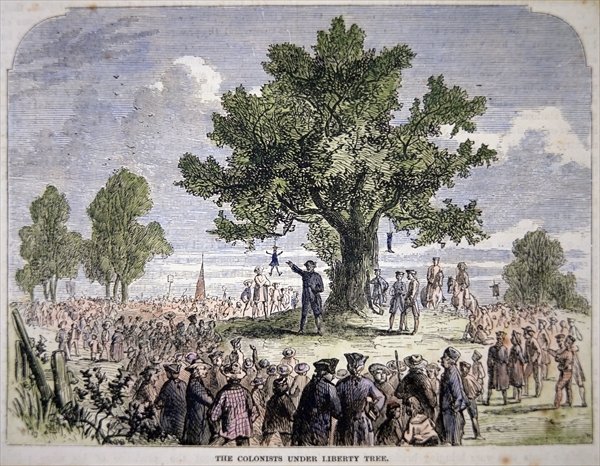
Brothers united in principle and gathered around the Liberty tree is what we need to be. Hyphenated Americans, those who promote class warfare and division, and those who see only superficial differences instead of overarching primary truths, have no place in America. As our forebears once told each other, “Join, or Die.” That’s our ultimatum – unite as a People or fall into tribalistic oblivion.







 The American Citadel