
I foresee no future in which our power grid won’t be attacked or otherwise taken down. Do you comprehend what a grid-down scenario means? Are you prepared for such a trying situation? If you haven’t thought seriously about our grid-down future or made any preparations for that approaching day, begin today.
First, let’s discuss in detail, citing several sources, how terribly vulnerable our power grid is and what the risks are. In 2017, the Council on Foreign Relations – one of the chief conspiratorial bodies working against the United States – reported:
“The U.S. power grid has long been considered a logical target for a major cyberattack. Besides the intrinsic importance of the power grid to a functioning U.S. society, all sixteen sectors of the U.S. economy deemed to make up the nation’s critical infrastructure rely on electricity. Disabling or otherwise interfering with the power grid in a significant way could thus seriously harm the United States. . . .

“Attacks on power grids are no longer a theoretical concern. In 2015, an attacker took down parts of a power grid in Ukraine. Although attribution was not definitive, geopolitical circumstances and forensic evidence suggest Russian involvement. A year later, Russian hackers targeted a transmission level substation, blacking out part of Kiev. In 2014, Admiral Michael Rogers, director of the National Security Agency, testified before the U.S. Congress that China and a few other countries likely had the capability to shut down the U.S. power grid. Iran, as an emergent cyber actor, could acquire such capability. Rapid digitization combined with low levels of investment in cybersecurity and a weak regulatory regime suggest that the U.S. power system is as vulnerable—if not more vulnerable—to a cyberattack as systems in other parts of the world.
“An adversary with the capability to exploit vulnerabilities within the U.S. power grid might be motivated to carry out such an attack under a variety of circumstances. An attack on the power grid could be part of a coordinated military action, intended as a signaling mechanism during a crisis, or as a punitive measure in response to U.S. actions in some other arena. In each case, the United States should consider not only the potential damage and disruption caused by a cyberattack but also its broader effects on U.S. actions at the time it occurs. With respect to the former, a cyberattack could cause power losses in large portions of the United States that could last days in most places and up to several weeks in others. The economic costs would be substantial. As for the latter concern, the U.S. response or non-response could harm U.S. interests. Thus, the United States should take measures to prevent a cyberattack on its power grid and mitigate the potential harm should preventive efforts fail.”
According to the CFR, our power grid’s vulnerabilities can be exploited by several nations – Russia, China, and Iran, notably – in wartime, or via cyberattacks. The “costs would be substantial.” That’s a gross understatement!
A 2021 article by the Senate Republican Policy Committee noted various ways our grid could be targeted:
“There is almost nothing more essential to day-to-day life in America than electricity generation and delivery. The U.S. electric grid is comprised of all of the power plants and other ways of generating electricity, together with the transmission and distribution lines and infrastructure that bring power to customers. Ensuring the cybersecurity of the electric grid is critical to safeguarding the reliability and resilience of the grid.
“The U.S. electric grid faces significant cybersecurity risks from a variety of actors, including criminals, terrorists, “hacktivists,” and foreign governments. The grid is vulnerable to cyberattacks that could cause catastrophic, widespread, and lengthy blackouts. The effect on hospitals, police departments, banks, gas stations, military bases, and families across America could be disastrous. . . .
“One of the greatest cybersecurity threats to the electric grid involves a mundane function known as “industrial control systems.” ICS are used to manage electrical processes and physical functions like opening and closing circuit breakers. These systems increasingly are being merged with technologies that connect to or rely on the internet. This enables remote monitoring and can improve cost and energy conservation, but it also creates more access points for hackers. . . .
“The 2021 annual threat assessment concluded, “Although an increasing number of countries and nonstate actors have [cyberattack] capabilities, we remain most concerned about Russia, China, Iran, and North Korea.” The report noted that Iran was responsible for multiple cyberattacks in 2020 against Israeli water facilities. Russia “continues to target critical infrastructure, including underwater cables and industrial control systems, in the United States and in allied and partner countries, as compromising such infrastructure improves − and in some cases can demonstrate − its ability to damage infrastructure during a crisis.”
“A 2020 assessment by the Department of Homeland Security warned “we remain concerned about China’s intent to compromise U.S. critical infrastructure in order to cause disruption or destruction.” Last month, Energy Secretary Jennifer Granholm confirmed that America’s adversaries are capable of shutting down the grid.”
Indeed, a grid-down scenario would be “disastrous.” Our enemies have been practicing taking grids down and hacking power stations. Our government is evil enough to do the same to further its ends. It’s only a matter of time before one of a host of “bad actors” pulls the trigger.
In October 2022, the ironically named U.S. Government Accountability Office published a report, complete with helpful diagrams, showing how the grid and smart appliances at home could be attacked. They noted:
“The U.S. electricity grid is really three interconnected transmission grids covering the contiguous United States, as well as parts of Canada and Mexico. It is roughly divided into the western states, Texas, and the eastern U.S. and Midwest. These three interconnections operate independently to provide electricity to their regions.

“There are several points of vulnerability in the U.S.’s system of electricity grids. For example, grid distribution systems—which carry electricity from transmission systems to consumers—have grown more vulnerable, in part because their operational technology increasingly allows remote access and connections to business networks. This could allow threat actors to access those systems and potentially disrupt operations. . . .
“The Federal Energy Regulatory Commission (FERC)—which regulates the interstate transmission of electricity—has approved mandatory grid cybersecurity standards. But it hasn’t taken steps to ensure that those standards fully address leading federal guidance for critical infrastructure cybersecurity. For example, and similar to the above, the standards do not include a full assessment of cybersecurity risks to the grid.
“In 2019, we recommended that FERC consider adopting changes to its approved standards to more fully address federal guidance and evaluate the potential risks of a coordinated attack. These recommendations have not been implemented yet, leaving the grid vulnerable.
“Finally, in March 2021, we found that the federal government does not have a good understanding of the scale of the potential impacts from attacks facing the component of the grid that is generally not subject to FERC’s standards: distribution systems.”
Government efficiency at its best. They know the threat. They know the vulnerability of the power grid. They know how horrific a grid-down scenario would be. Yet, they do nothing. They employ half-measures. They don’t seriously warn the public or take steps to prepare us. While apathy and ignorance surely play a part in why government leaders and their controllers don’t do anything to help prepare the public, I believe many of them want a grid collapse.
There would be no better way to make the entire nation suddenly dependent upon a power that can ride in and save them from destruction than to cut them off from electricity and make them watch helplessly as their entire world grinds to a halt. Remember, these sick people have unleashed bio-weapons on us, foisted poisoned vaccines on the world, lied to take us to war for profit and private agendas, covered up treachery, wage war against their political opponents, ad infinitum. Do you trust these conniving criminal conspirators?
They admit they want a “Great Reset” that involves your slavery to their international plutocracy. They admit they want to take your wealth and property. They admit they want you to live in smart cities where you can never leave – a form of Hunger Games-style high-tech feudalism. A grid-down reality would allow a bigger opportunity to “reset” things than any other situation I can imagine; perhaps even greater than nuclear world war – which is also inevitable. See my in-depth article “The Inevitability of Nuclear War.”
In February of this year, Chuck Brooks wrote in Forbes of the aged condition of our power grid and three “alarming threats” facing it. It’s a more technical and thorough article and I recommend it:
“The underlying reality is that from an energy frequency perspective, the aging U.S. Energy Grid infrastructure is extremely vulnerable to cyber-attacks, physical incidents, and existential threats. . . .
“Although in recent years the grid has been augmented with automation and some emerging tech, It is still mostly dependent on legacy technologies. In fact, 70 percent of transmission lines are at least 30 years old and approaching the end of their lifecycle, and 60 percent of the circuit breakers are more than 35 years old, compared to useful lives of 20 years.
“The aging infrastructure and increasing demand for power have made the grid susceptible to “cascading failures,” where the failure of one component leads to a series of failures. This has been witnessed during periods of harsh weather. . . .
“The new reality is that most of the U.S. Energy Grid critical infrastructure components operate in a digital environment that is internet accessible. The trends of integration of hardware and software combined with growing networked sensors are redefining the surface attack opportunities for hackers.
“The gaps for cyber-attackers have been recognized by government and industry. The General Accounting Office (GAO) has explicitly stated that the U.S, Energy Grid is vulnerable to cyber-attacks. The GAO notes that the grid distribution systems—which carry electricity from transmission systems to consumers—” have grown more vulnerable, in part because their operational technology increasingly allows remote access and connections to business networks. This could allow threat actors to access those systems and potentially disrupt operations.” . . . .
“The fact is that cyber-attacks are evolving in sophistication enabled by artificial intelligence. Also, state actors, criminal gangs, and other attackers are homing in on energy critical infrastructure. Connectivity driven by the adoption of industrial internet of things and operational technology has further expanded the attack surface and energy infrastructure operators should implement “security by design” to counter cyber threats. Cybersecurity by design necessitates building agile systems with operational cyber-fusion to be able to monitor, recognize and respond to emerging threats. The bottom line is that cybersecurity for the U.S. Energy Grid must be elevated. . . .
“As if cyber-attacks were not enough of a security concern, physical attacks by domestic terrorists on the U.S. Energy Grid are an increasing threat. Based on data from DOE, physical attacks on the grid rose 77% in 2022. . . .
“In January 2023, a bulletin from the Department of Homeland Security (DHS) warned that domestic violent extremists “have developed credible, specific plans to attack electricity infrastructure since at least 2020, identifying the electric grid as a particularly attractive target.” . . . .
“The existential threat to the U.S. Energy Grid can come from a variety of angles. Both weather and solar storms, are top factors for power outages in the United States (one other big factor is outages from squirrels hanging out on transformers and transmission lines!). Hurricanes, tornados, fires, floods, and other acts of nature can have devastating impact on power plants, transformers and transmission lines. . . .
“Solar storms are a different existential threat to address. Solar flares are made up of high-energy particles resulting from explosions on the Sun’s surface. A geomagnetic storm can be defined as a major disturbance of Earth’s magnetosphere that occurs when there is an exchange of energy from the solar wind into the space ecosphere surrounding Earth.
“Over the past 150 years, the earth has been struck by more than 100 solar storms In 2008, the National Academy of Sciences estimated that the damage and disruption of the grid caused by a solar flare could cost up to $2 trillion in economic damages, with a full recovery time of four to 10 years. . . .
“Testimony at the Hearings from the late Dr. Peter Prye, a member of the Congressional EMP Commission and executive director of the Task Force on National and Homeland Security, put the threats in frightening perspective: “Natural EMP from a geomagnetic super storm, like the 1859 Carrington Event or 1921 Railroad Storm, and nuclear EMP attack from terrorists or rogue states, as practiced by North Korea during the nuclear crisis of 2013, are both existential threats that could kill 9 of 10 Americans through starvation, disease and societal collapse.”
“Dr. Prye also noted that “a natural EMP catastrophe or nuclear EMP event could black out the national electric grid for months or years and collapse all the other critical infrastructures — communications, transportation, banking and finance, food and water — necessary to sustain modern society and the lives of 310 million Americans.”
“The underlying reality is that the US electric grid infrastructure is extremely vulnerable to physical, cyber, and forces of nature incidents. Helping reduce the vulnerability and fortify the U.S. Energy Grid has become an urgent need, and the clock is ticking.”
I seriously dispute that 9/10 Americans would die in a grid-down situation, but who can dispute that tens of millions would perish and that it would upend our society? We would lose more of our people within the first weeks of such a hellish scenario than in all the wars we’ve fought combined. It would be nothing short of catastrophic. The economy would fail, law and order would vanish, mob violence would rage, and last vestiges of sanity would flee. We’d be living an 1800s lifestyle overnight.
This article hit upon one of the reasons I believe a grid-down situation is inevitable – solar flares. Regardless of what happens on earth, the sun may intervene and plunge us into darkness at any moment. We briefly examine the Carrington Event to see what happened in 1859 and what could happen again. To summarize what happened during that exceptional event, Space.com has written:
“On Sep. 1, as [Richard] Carrington was sketching the sunspots, he was blinded by a sudden flash of light. Carrington described it as a “white light flare” according to NASA spaceflight. The whole event lasted about five minutes.
“The flare was a major coronal mass ejection (CME), a burst of magnetized plasma from the sun’s upper atmosphere, the corona. In 17.6 hours, the CME traversed over 90 million miles (150 million km) between the sun and Earth and unleashed its force on our planet. According to NASA spaceflight, it usually takes CMEs multiple days to reach Earth.
“The day after Carrington observed the impressive flare, Earth experienced an unprecedented geomagnetic storm, with telegraph systems going haywire and auroral displays — normally confined to polar latitudes — visible in the tropics, according to NASA Science.
“Carrington put two and two together and realized that the solar flare he’d seen was almost certainly the cause of this massive geomagnetic disturbance. This was a connection that had never previously been made, according to NASA Spaceflight. The solar storm of 1859 is now known as the Carrington Event in his honor.
“The origins of space weather can be traced to contortions in the sun’s magnetic field, leading to dark blotches or sunspots on its surface, according to NASA Earth Observatory.
“It’s from these spots that solar flares, coronal mass ejections and other electromagnetic phenomena can emerge — with potentially hazardous consequences for our technological way of life.

“Sunspot activity rises and falls on an 11-year cycle, and we’re currently approaching the next solar maximum in 2025. So now is a good time to look at the worst solar storms.
“The Carrington Event sparked a huge geomagnetic storm that wreaked havoc with technology. Earth fell silent as telegraph communications around the world failed.
“According to History.com, there were reports of sparks showering from telegraph machines, operators receiving electric shocks and papers set ablaze by the rogue sparks.
“Striking auroras dazzled skywatchers around the world as polar light shows stretched far beyond their usual ranges. The northern lights (aurora borealis) were witnessed as far south as Cuba and Honolulu, Hawaii, whilst the southern lights (aurora australis) were seen as far north as Santiago, Chile, according to National Geographic. . . . .
“It’s been conjectured that a storm on the scale of the Carrington event, if it happened today, could cause an internet apocalypse, sending large numbers of people and businesses offline. For this reason, the U.K. government lists adverse space weather as one of the most serious natural hazards in its National Risk Register, and companies have contingency plans to deal with severe events — as long as they have sufficient warning of them.”
For more about the Carrington Event and CMEs, see here, here, here, and here.
Mother nature does what she wants to and her fury trumps man’s might. We may have gained limited supremacy over certain natural laws, such as the law of gravity, but when nature strikes, humanity has no recourse but through faith, prayer, and purity that can call down God’s protective power.
Who can halt a rushing wall of water from a tsunami? Who can put a lid on the fiery wrath of volcanic explosions? Who can stop earthquakes from splitting apart the ground and toppling buildings? Who can prevent hurricanes and tornadoes from ripping apart cities and homes? Who can stop hailstorms from destroying crops? Who can counter excessively harsh winters that stop plane flights, block roads, and topple power lines? Who can push back the sun when it projects its power in our direction? It is arrogance to think, if Russia and China don’t do it to us first, that our power grid won’t at some point be rocked by the uncontrollable fierceness of Mother Nature.
In May 2023, Reuters published a piece on the U.S. power grid’s vulnerability to extreme weather and because of idiotic environmental regulations. It commented on a report by the North American Electric Reliability Corp (NERC), stating:
““Wildfire risks to the transmission network, which often accompany these wide-area heat events, can limit electricity transfers and result in localized load shedding,” NERC said.
“In the U.S. Midwest, NERC said the Midcontinent ISO could face challenges in meeting above-normal peak demand if wind generator energy output is lower than expected.
“In Texas, NERC said resources are adequate for peak demand of the average summer as the state has added over 4 gigawatt of new solar capacity to its grid since last year.
“But the group warned that “dispatchable generation may not be sufficient to meet reserves during an extreme heat-wave that is accompanied by low winds.”
“NERC said New England and Ontario may need to rely on non-firm imports during extreme demand or low resource conditions, while the Southeast is vulnerable due to flat growth in generating resources.

“Limited operation of coal-fired power plants due to new environmental regulations, low water levels on major reservoirs, unexpected tripping of wind and solar resources, and curtailed transfers to areas in need also posed reliability concerns, NERC added.
“NERC has become more assertive in warning about reliability concerns in recent years after power grid operators were forced to impose rotating outages in California in August 2020 and in Texas in February 2021.”
Imagine that, radical Marxist environmentalist regulations are endangering us all. They make a vulnerable system even more fragile and unreliable. But don’t worry, people are being more “assertive” about the danger – as if the will and desires of the People ever changed the incompetence and iniquity of government.
Tripwire has raised yet another warning voice about the reckless vulnerability of the grid:
“Energy is one of the 16 sectors that the Department of Homeland Security has identified as critical infrastructure in the U.S. It is arguably the most important, because it supplies the energy required to power every other essential infrastructure sector. Regrettably, the electric grid is insufficiently secure against both physical attacks and cyber intrusions.
“When there is a disruption in the electrical grid, it’s often merely a matter of short-lived inconvenience. But what if the outage engulfed not just a confined area but a wide swath of the country, and the power went out for a week or more? Many aspects of life would freeze, and the likelihood of potential casualties would skyrocket. Minor annoyances, such as the inability to recharge a cell phone or the lack of internet, would quickly yield to greater concerns, such as having no water to drink, no household heat or air conditioning. In addition, there might be no gas for automobiles or generators, and both local and national emergency systems, such as the ability to call an ambulance might be inoperative as well.
“The number of direct physical attacks on U.S. power grids soared 77 percent last year to 163, a record-high, according to the US Energy Department. Since last September, attacks were reported on 18 substations and one power plant each in Florida, Oregon, Washington and the Carolinas. The attacks underscored the vulnerability of the U.S. electric grid, which keeps electricity flowing across more than 470,000 miles of circuits and includes more than 7,300 power plants, 160,000 miles of high-voltage power lines and 55,000 transmission substations.
“Substations, which increase electricity voltage so that it can flow into big transmission lines, are the biggest targets. But they are mostly in rural or semi-rural areas and typically unprotected.”
Americans are, by and large, naïve of the danger facing them. Who would want to truly hurt us? How could they hurt us at home? We’re generally good folks who want to be left alone. As such, we’re trusting and we ignore things that should raise red flags.
Because of the openness of our society, we’re wide open and exposed to major attacks on our water supply, food production facilities, infrastructure, power grid, and beyond. When such attacks come, they will be devastating because few are prepared – these attacks aren’t even on their radar. You can’t prepare for what you haven’t contemplated.
It’s long past time to start thinking seriously about a grid-down scenario. Even though it’s only a matter of time before a solar flare hits us, more than likely mankind will strike before Mother Nature has her chance. Our enemies know our weaknesses; they have helped design and maximize them! America’s takedown was planned decades ago. The enemy has been methodically following its blueprint and is reaching the conclusion. We don’t know it, but we’re in mortal peril. In the blink of an eye, we could be attacked and reduced to Pioneer days. It won’t come that suddenly for those who pay attention, but those who haven’t begun following the goings on in the world, and who haven’t begun preparing for their logical conclusion, will be startled into stunned paralysis.
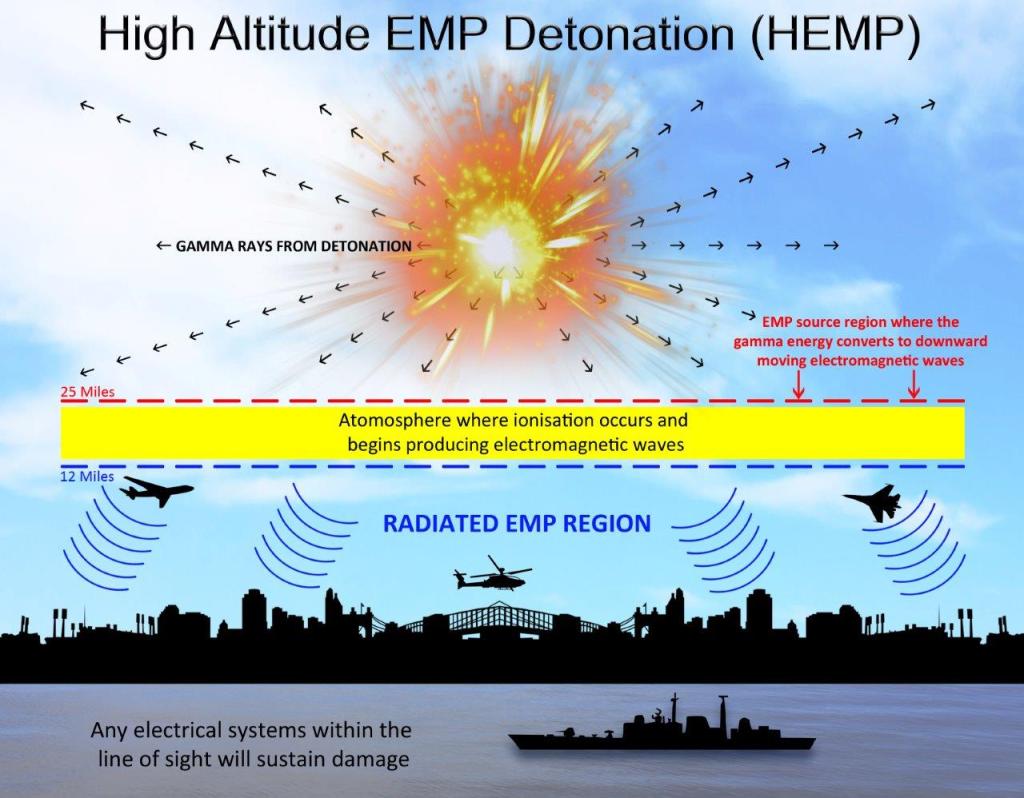
In a recent interview with Canadian Prepper, “Green Gregs” Gregory Allison, a rocket scientist whose channel I’ve followed for some time, made this statement about an EMP attack:
“An EMP doesn’t directly hurt anybody. You don’t kick over dead and start doing the funky chicken because an EMP. What happens is you die as a result of loss of infrastructure because you’ve got no water, no fuel, no communications, no bank account, no cellphone. It’s all gone. Electricity is the one critical keystone to all of our 14 critical infrastructure elements. Without electricity, you can’t pump fuel. Without electricity, you don’t pump water, you don’t have sanitation, all these things that we rely on. Everything is electrical powered. And now we’re trying to make things more electrical powered. So, we’ve got a lot of issues with our grid. And this is known by all our adversaries. They know this is our Achilles heel. They know that this is a way to put us out of business.”
You know what an Achilles heel is. It’s the weak point. It’s the vulnerability. It’s the place where, if you hit it, you can destroy that which was otherwise impregnable. America is strong, but the power grid is our major Achilles heel. Its collapse the thing few have thought of and fewer still have prepared for. People in general have no conception of how dramatically a crash would impact them.

While some things would still operate sporadically, generally, people would have no water, no electricity, no light at night, no “smart” anything, no cellphones, no cars, no mobility, no banks, no and digital money. Could you survive?
Could you really endure and survive with no electricity, no lights, no power, no water, no car, no phone? Could you survive the diseases that will spring up because of the terrible sanitation, sewage backups, and decreases in hygiene that will occur? Do you have a way to survive when our nuclear power plants meltdown in the aftermath of a grid-down scenario
Do you have a contingency plan to meet with your family if suddenly communications were down? Do you have a backup plan in case you can’t get there because cars stopped running or the roadways were clogged with refugees? Do you have backup water supplies no dependent upon an electric pump? Do you have food storage on hand so that you don’t have to go to a store or leave your residence? Do you have a power generator? Do you have alternative ways to heat your home if there was no power in winter? Have you ever considered these possibilities?
As we wrap up this up, we point you to several links with tips on how to survive a grid-down scenario:
“How to Survive If the Power Grid Goes Down: Power Grid Failure Preparedness Guide”
“Preparing for Grid Down: My Step-By-Step To-Do List”
“What to Do When the Power Goes Out (12 Things to Prepare)”
“Will You Survive the Next Power Grid Outage?”
“Grid Down Emergency Preparedness for Beginners”
“Blackout: What to Do When the Grid Goes Down”
“Life After Losing the Electric Grid”
“Grid down survival guide – Prepare for a grid down event”
I leave you to do your own homework on how to best safeguard your family and survive our inevitable grid-down future. However, I share one final quote from the top link on the list above:
“If you’re going to prepare for one disaster, a medium- to long-term power outage is the one. America’s power grid is woefully inadequate, outdated and ill-prepared for an attack or even a natural disaster. Whether it comes in the form of an EMP from North Korea or Chinese hackers or any other source, the power grid isn’t something that you can rely upon on a daily basis. You need to know how to survive a power grid attack, or at least prepare yourself for a power outage.”
You still have time to prepare, but prepare now. It’s getting late.
Zack Strong,
June 19, 2023
 The American Citadel
Pingback: Are You Taking This Seriously? | The American Citadel